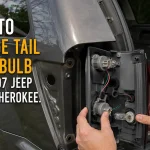
If you are replacing a burned-out rear light on a 1993 Jeep Wrangler, the bulb number you will most commonly encounter for the tail/brake-light function is 1157. The 1157 is a dual-filament, dual-contact bulb designed to handle two brightness levels, which makes it suitable for combined tail and brake-light duties.
However, there is a reason Jeep owners sometimes see 2057 mentioned when shopping for 1987–1993 Wrangler YJ bulbs. Parts catalogs list 2057 bulbs for certain YJ lighting applications as well, including front parking/turn-signal applications.
Because a 1993 Wrangler may also have replacement housings, aftermarket lights, or previous wiring changes, the safest approach is to check the number printed on the bulb you remove before ordering a replacement.
Quick Answer: What Bulb Does a 1993 Jeep Wrangler Tail Light Use?
For a stock-style 1993 Jeep Wrangler YJ rear tail/brake light, start with an 1157 bulb.
An 1157 is a dual-function bulb. One circuit provides the lower-intensity tail or parking light, while the other provides the brighter brake-light output. Philips also identifies the 1157 format as a stop/tail application with a BAY15d base.
Before installing one, compare it with the old bulb. That quick check can save you from buying the right bulb number for the wrong lamp position.
1993 Jeep Wrangler Tail Light Bulb Size at a Glance
Here is the most useful way to think about the rear lighting on a 1993 Wrangler YJ:
| Light Function | Common Bulb Type | What to Know |
|---|---|---|
| Tail/Parking Light | 1157 commonly listed | Lower-intensity circuit |
| Brake Light | 1157 commonly listed | Brighter circuit of the same dual-filament bulb |
| Rear Turn Signal | Check existing bulb/application | YJ listings can vary by lamp position |
| Reverse Light | Often a single-function bulb | Do not assume it is interchangeable with the tail/brake bulb |
| Front Parking/Turn Signal | 2057 appears in 1987–1993 YJ listings | Different position from the rear tail lamp |
Fitment listings from AutoZone and eTrailer include 1157 replacements for 1993 Wrangler brake/tail applications, while Quadratec’s YJ data also shows 2057 fitment for 1987–1993 Wranglers in other lighting positions.
The important point is simple: do not choose a bulb only because it is listed somewhere for a 1993 Wrangler. Make sure it is listed for the exact lamp position you are repairing.
Is a 1993 Jeep Wrangler a YJ?
Yes. The 1993 Jeep Wrangler belongs to the YJ generation, which covers the first-generation Wrangler.
That matters when shopping for bulbs because search results often mix parts for the YJ with later TJ, JK, and JL Wranglers. A bulb that fits a newer Wrangler is not automatically correct for your 1993 model.
When searching online, phrases such as 1993 Jeep Wrangler YJ tail light bulb or 1993 YJ brake light bulb usually produce more relevant results than simply searching for “Jeep Wrangler bulb.
Is the 1993 Jeep Wrangler Tail Light Bulb 1157 or 2057?
This is where many owners get confused.
For the rear stop/tail application, 1157 is the bulb number you will commonly see listed for a 1993 Wrangler. AutoZone’s Wrangler brake and tail-light listings include the Sylvania 1157, and eTrailer’s 1993 Wrangler vehicle-light catalog also lists 1157 tail-light replacements.
The 2057 number also appears in 1987–1993 Wrangler YJ parts catalogs, but that does not mean every 2057 listing refers to the rear tail light. For example, a Quadratec Sylvania 2057 listing identifies the bulb for the front parking lamp/turn signal on 1987–1993 YJs.
So, if your goal is replacing the rear tail/brake bulb, do not automatically substitute a 2057 simply because a product page says it fits a 1993 YJ.
Check three things:
- The number printed on the old bulb
- The number of contacts on the bulb base
- The exact position listed in the replacement-bulb catalog
That is much more reliable than shopping by vehicle year alone.
1157 vs. 2057: What Is the Difference?
The 1157 and 2057 are similar dual-filament automotive bulbs, which is why they are sometimes discussed together.
Both may appear in stop, tail, parking, or turn-signal applications depending on the vehicle. However, their original specifications and intended applications are not identical.

| Feature | 1157 | 2057 |
|---|---|---|
| Dual-function design | Yes | Yes |
| Common tail/brake use | Yes | Yes on various vehicles |
| Similar bayonet-style fitment | Often | Often |
| Automatically correct for every 1993 YJ position | No | No |
| Should you verify the old bulb? | Yes | Yes |
For a 1993 Wrangler, vehicle-position fitment matters more than simply asking whether an 1157 and 2057 can physically fit a similar socket.
Are the Tail Light and Brake Light the Same Bulb on a 1993 Jeep Wrangler?
In a stock-style combined stop/tail setup, they can be two functions of the same dual-filament bulb.
Think of the bulb as having two operating levels.
Tail Light Function
When you turn on the parking lights or headlights, the lower-output circuit illuminates. This gives other drivers a steady red rear marker at night.
Brake Light Function
When you press the brake pedal, the brighter circuit illuminates so drivers behind you can immediately tell that the Jeep is slowing down.
This is why a bulb can sometimes appear to “still work” even though one function has failed.
An 1157-format bulb is designed for this type of stop/tail use, and Philips identifies its 1157 replacement with a BAY15d base and P21/5-style stop/tail configuration.
Why Can a Tail Light Work but the Brake Light Not Work?
A dual-filament bulb does not have to fail completely.
One filament or circuit may fail while the other remains functional.
For example, you may turn on the headlights and see the rear lamp glowing normally, then press the brake pedal and notice that the lamp does not become brighter.
That can point to a failed brake-light filament.
The opposite can also happen: the brake light works, but the normal nighttime tail-light function does not.
Before assuming there is a major wiring problem, replacing or testing the bulb is a sensible first step.
1156 vs. 1157: Do Not Buy the Wrong Bulb
Another common source of confusion is 1156 vs. 1157.
These are not simply two names for the same bulb.
The 1157 is intended for dual-function applications. Its two circuits allow one bulb to perform functions such as tail and brake lighting.
An 1156-style bulb is normally a single-function bulb.
That means you should not automatically install an 1156 in a socket designed for an 1157 simply because the bulbs look similar from a distance.
Quadratec lists an 1156 bulb for several Wrangler YJ lighting applications, which is another reason to identify the exact lamp position rather than shopping by Jeep model alone.
Easy Rule to Remember
1157 = dual-function style
1156 = single-function style
Always confirm the actual socket and factory application before installation.
What Type of Base Does an 1157 Bulb Use?
The standard 1157 format uses a BAY15d-style dual-contact bayonet base.
Instead of screwing into the socket like a household bulb, the bulb is inserted into the socket and turned to lock it in place.
Philips specifies BAY15d for its 1157 automotive signaling bulbs.
This matters when buying LED replacements because an LED can be advertised as a “tail light bulb” while using a completely different base.
Match the bulb number and base style, not just the description on the package.
How to Replace a Tail Light Bulb on a 1993 Jeep Wrangler YJ
Replacing a YJ tail-light bulb is a straightforward job for most owners.
You normally do not need specialized tools or advanced electrical knowledge.

What You’ll Need
Have these items ready:
- Correct replacement bulb
- Phillips screwdriver
- Clean gloves or cloth
- Small flashlight if visibility is poor
If the lens screws are old or rusty, use gentle pressure rather than forcing them.
Step 1: Turn Off the Jeep and Lights
Park the Jeep on a flat surface.
Switch off the ignition, headlights, parking lights, and hazard lights.
This gives you a safer starting point and makes it easier to see whether the replacement fixed the problem when you test everything later.
Step 2: Remove the Tail Light Lens
Move to the rear lamp that contains the failed bulb.
Remove the screws securing the tail-light lens or housing cover.
Keep the screws somewhere safe. YJ hardware is old enough that losing or damaging one can turn a five-minute bulb job into an annoying parts search.
Step 3: Identify the Failed Bulb
Do not immediately pull out every bulb in the housing.
Identify the bulb responsible for the failed function.
If necessary, compare the driver’s and passenger’s sides.
This is also the best time to confirm the bulb number printed on the glass or base.
Step 4: Remove the Old Bulb
For a bayonet-style bulb, gently press it inward and rotate it counterclockwise.
Then pull it straight out of the socket.
If it feels stuck, inspect the socket for corrosion before applying more force.
Step 5: Inspect the Socket
Before installing the new bulb, spend ten seconds looking inside the socket.
Watch for:
- Green or white corrosion
- Burned contacts
- Melted plastic
- Loose terminals
- Moisture
- Dirt or debris
Installing a new bulb into a badly corroded socket may give you the same problem immediately.
Step 6: Install the New Bulb
Align the bulb’s locating pins with the socket.
Press it in gently and rotate it clockwise until it locks.
Do not force the bulb. If it will not seat normally, stop and compare it with the bulb you removed.
Step 7: Reinstall the Lens
Position the lens correctly and reinstall the screws.
Tighten them enough to hold the lens securely, but do not overtighten old plastic components.
Step 8: Test Every Function
Do not test only the function that originally failed.
Check:
- Parking/tail lights
- Brake lights
- Left turn signal
- Right turn signal
- Hazard lights
- Reverse lights
If possible, have another person press the brake pedal while you watch the rear lamps.
How Can You Tell If the Tail Light Bulb Is Bad?
A failed bulb does not always mean a completely dark lamp.
Possible symptoms include:
- One tail light does not illuminate
- The brake light does not become brighter
- The brake light works but the tail light does not
- The lamp flickers when driving
- One side looks noticeably dimmer
- The bulb works when moved or tapped
- The glass inside the bulb appears dark
- A filament is visibly broken
If replacing the bulb fixes the problem, you are done.
If the new bulb behaves exactly like the old one, keep troubleshooting.
Tail Light Still Not Working After Replacing the Bulb?
Do not keep buying bulbs.
Once you have confirmed that the replacement bulb is correct and known to be good, move to the electrical side of the problem.
Check the Bulb Socket
Older sockets can develop corrosion or weak contact pressure.
If moving the bulb makes the light flicker, pay close attention to the socket.
Check the Ground
A poor ground can cause strange rear-light behavior, including dim lights, intermittent operation, or one circuit affecting another.
This is especially worth checking on an older Jeep that has seen mud, water, road salt, body repairs, or previous electrical modifications.
Check the Fuse
If more than one lamp has stopped working, inspect the appropriate lighting fuse.
Do not replace a repeatedly blown fuse with a higher-amperage fuse. A fuse that keeps failing may be warning you about a short circuit.
Inspect the Wiring
Look for:
- Damaged insulation
- Loose connectors
- Trailer-wiring splices
- Corroded terminals
- Previous owner modifications
Trailer-light wiring deserves special attention because it is often spliced into the Jeep’s rear lighting circuits.
Check the Brake-Light Switch
If both brake lights fail but the normal tail lights still operate, the problem may be farther upstream than the bulbs themselves.
The brake-pedal switch and associated wiring become more relevant when both sides fail at the same time.
Why Is One Tail Light Dimmer Than the Other?
A dim lamp is often a clue rather than a bulb-size problem.
Possible causes include:
- Poor ground
- Corroded socket
- Weak electrical connection
- Incorrect bulb
- Old bulb
- Damaged wiring
- Dirty or faded lens
Compare both sides with the same lighting function switched on.
If one side is dramatically weaker even with matching bulbs, inspect the socket and wiring rather than immediately purchasing a brighter bulb.
Can You Use LED Tail Light Bulbs in a 1993 Jeep Wrangler?
Yes, LED replacements are available in the 1157 format, including red stop/tail versions. Philips, for example, offers an 1157 LED signaling bulb with a BAY15d base for stop/tail applications.
That does not mean every LED labeled “1157” is automatically a good choice for a YJ.
Check:
- Physical bulb size
- Base compatibility
- Polarity
- Light distribution
- Lens color
- Turn-signal behavior
- Local road regulations
LEDs draw less electrical current than traditional incandescent bulbs. In circuits used for flashing signals, that lower load can sometimes change flash behavior unless the flasher system is compatible.
For a simple stock-style repair, a quality incandescent bulb is often the easiest option.
For an LED upgrade, choose a reputable bulb designed for automotive stop/tail use rather than an unknown high-output LED that happens to fit the socket.
Incandescent vs. LED Tail Light Bulbs for a Jeep YJ
| Feature | Incandescent | LED |
|---|---|---|
| Stock-style operation | Excellent | Usually good when compatible |
| Purchase price | Usually lower | Usually higher |
| Installation complexity | Very low | May require extra compatibility checks |
| Response speed | Normal | Faster illumination |
| Power consumption | Higher | Lower |
| Classic factory appearance | Better match | More modern appearance |
| Potential flasher issues | Unlikely | Possible in signal applications |
If your priority is simply getting your 1993 Wrangler back on the road with factory-like behavior, incandescent is the uncomplicated choice.
If you want an LED upgrade, treat it as an upgrade rather than assuming it behaves exactly like the original bulb.
Should You Replace Both Tail Light Bulbs at the Same Time?
You do not have to replace both bulbs just because one fails.
However, replacing them as a pair can make sense when both bulbs are the same age.
Incandescent bulbs gradually age, so if one original or older bulb has failed, the bulb on the opposite side may not be far behind.
A matched pair can also help keep rear-light brightness consistent.
What to Check Before Buying a Replacement Bulb
Before clicking “Buy Now” or walking out of an auto-parts store, verify these points:
- Confirm that your vehicle is a 1993 Jeep Wrangler YJ.
- Identify whether you are repairing the tail, brake, turn, or reverse function.
- Remove the old bulb and check its number.
- Compare the number of contacts on the base.
- Check the socket for previous modifications.
- Make sure an LED replacement is designed for the correct function if you are upgrading.
- Do not assume every bulb listed for a 1987–1993 YJ belongs in the rear tail-light position.
That last step is important because catalogs may list multiple bulb numbers for the same vehicle year while referring to completely different lights. Quadratec, for example, lists 2057 applications for 1987–1993 YJs, while other fitment sources list 1157 for 1993 Wrangler rear tail/brake service.
US, UK, Canada, and Australia Tail-Light Terminology
If you are searching for parts outside the United States, the wording may change even when the lighting function is similar.
In the US and Canada, you will commonly see terms such as:
- Tail light
- Brake light
- Parking light
- Turn signal
In the UK and Australia, listings may also use:
- Rear position lamp
- Stop lamp
- Indicator
- Reversing lamp
You may also encounter P21/5W-style terminology for dual-function stop/tail lamps. Philips associates its 1157 stop/tail format with the P21/5 type and BAY15d base.
Because imported vehicles can have different lamp assemblies or previous conversions, check the physical bulb before relying on a regional name alone.
Frequently Asked Questions
What bulb is a tail light on a 1993 Jeep Wrangler?
The 1157 is commonly listed for the rear tail/brake-light application on a 1993 Jeep Wrangler YJ. Confirm the bulb removed from your Jeep before purchasing because older Wranglers may have replacement or modified lamp assemblies.
What size tail light bulb does a 1993 Jeep Wrangler use?
For the stock-style rear stop/tail function, look for an 1157 dual-function bulb. The 1157 format uses a dual-contact BAY15d-style base.
Does a 1993 Jeep Wrangler use an 1157 bulb?
Yes, 1157 bulbs are listed for 1993 Wrangler rear lighting applications, including brake/tail replacements.
Does a 1993 Jeep Wrangler use a 2057 bulb?
2057 bulbs appear in 1987–1993 Wrangler YJ fitment catalogs, but the exact lamp position matters. One Quadratec listing specifies the 2057 for the front parking/turn-signal application on 1987–1993 YJs, so do not assume it is automatically the correct rear tail bulb.
Can I replace a 2057 with an 1157?
Do not make the swap based only on similar appearance. Confirm the socket, lamp function, and original bulb number. Similar bulb families can appear in different positions on the same vehicle.
Are 1157 and 2057 bulbs interchangeable?
They are similar dual-function bulb types used in many automotive applications, but you should follow the fitment for the specific lamp position rather than treating them as universally interchangeable.
What is the difference between 1156 and 1157 bulbs?
The easiest practical distinction is that an 1156-style bulb is normally single-function, while an 1157-style bulb is dual-function. The 1157 can therefore support combinations such as tail and brake lighting.
Are the brake light and tail light the same bulb?
They can be. A dual-filament 1157-style bulb can provide both the lower-intensity tail-light function and the brighter brake-light function.
Why does my tail light work but my brake light doesn’t?
One circuit or filament inside a dual-function bulb may have failed while the other still works. Replace or test the bulb first, then inspect the socket, wiring, grounds, and brake-light circuit if the problem remains.
Why does my brake light work but my tail light doesn’t?
The lower-output tail-light circuit may have failed while the brighter brake-light circuit still works. A failed filament, poor socket connection, ground problem, or wiring fault can cause this symptom.
Can I install LED tail light bulbs in a 1993 Jeep Wrangler YJ?
Yes. 1157-format LED stop/tail bulbs are available. Make sure the LED matches the base, physical dimensions, light function, and electrical behavior of your Jeep before installing it.
How do you change a tail light bulb on a Jeep YJ?
Switch off the lights, remove the tail-light lens, identify the failed bulb, press and rotate the bayonet-style bulb out of its socket, install the correct replacement, reinstall the lens, and test all rear-light functions.
Final Answer: Which Bulb Should You Buy for a 1993 Jeep Wrangler?
If you are replacing the rear tail/brake bulb on a stock-style 1993 Jeep Wrangler YJ, the 1157 is the best bulb number to check first. It is a dual-function stop/tail bulb, and multiple vehicle-fitment sources list 1157 replacements for the 1993 Wrangler.
Do not buy solely by vehicle year, though. A 1993 YJ uses different bulbs in different lamp positions, and 2057 bulbs also appear in YJ catalogs for other applications.
For the safest repair, remove the old bulb, read the number stamped on it, compare the contacts and base, and verify that the replacement is specifically listed for the rear tail/brake position.
That extra minute of checking is much easier than installing the wrong bulb and wondering why the light still does not work.