Understanding Your 2012 Jeep Wrangler Brake Light System
The 2012 Jeep Wrangler JK features a dual-function tail light assembly that houses the brake light, turn signal, and tail light in a single housing. The brake light function is activated when you press the pedal, sending a signal to the bulb to illuminate at full brightness. This is distinct from the tail light, which runs at a lower intensity when your headlights are on. The factory configuration uses a 3157 or 4157 bulb, which is a dual-filament design: one filament for the running light and one for the brake/turn signal.
Understanding this dual-filament setup is crucial because a common failure mode is that one filament burns out while the other remains functional. You might notice your tail light works, but the brake light does not illuminate when you press the pedal. Conversely, the brake light might flash but the running light stays dark. This is a clear indicator that the bulb needs replacement, not necessarily a wiring or fuse issue. The bulb socket is designed with offset pins to ensure correct orientation, preventing you from installing the bulb backwards.
For off-road enthusiasts, the stock bulbs are often considered a weak point. They produce a warm, yellowish light that can be difficult to see in bright sunlight or dusty conditions. Additionally, the incandescent bulbs generate significant heat, which can degrade the plastic housing over time. Knowing these limitations helps you make an informed decision when it comes time to replace a burnt-out bulb. You are not just fixing a problem; you have an opportunity to upgrade your vehicle's safety and visibility.
Step-by-Step Guide to Replacing the Brake Light Bulb
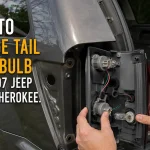
Replacing the brake light bulb on a 2012 Jeep Wrangler is a straightforward task that requires no special tools, though a flathead screwdriver or trim removal tool is helpful. Begin by parking your Jeep on a level surface and turning off the engine. Open the tailgate to access the interior of the cargo area. On the side of the vehicle where you need to replace the bulb, locate the two plastic access panels inside the cargo area, near the tail light housing. These panels are held in place by push-pins or clips.
Use your screwdriver or trim tool to gently pry the access panel off. Be careful not to break the plastic clips, as replacements can be difficult to find locally. Once the panel is removed, you see the back of the tail light assembly. There will be a large plastic wing nut or a set of three 10mm nuts holding the entire tail light housing to the body. For most 2012 models, you will need to turn the wing nut counterclockwise by hand, or use a socket wrench for the nuts. Remove the nuts and set them aside in a safe place.
With the nuts removed, gently pull the entire tail light housing straight out from the body. It may be snug due to a rubber gasket. Disconnect the wiring harness by pressing the release tab on the connector and pulling it apart. Now, locate the bulb socket for the brake light; it is typically the larger of the two sockets. Twist the socket counterclockwise and pull it out. Remove the old bulb by pulling it straight out of the socket. Insert the new 3157 or 4157 bulb ensuring the metal pins align with the slots. Push firmly until it clicks into place. Reinstall the socket by twisting it clockwise, reconnect the wiring harness, and press the housing back into the vehicle. Secure the nuts or wing nut, replace the access panel, and test your lights.
Troubleshooting Common Brake Light Issues
Even after replacing the bulb, you might encounter issues where the brake light still does not function correctly. The most common culprit is a poor connection at the bulb socket. Corrosion can build up on the metal contacts inside the socket, preventing a solid electrical connection. To fix this, use a small wire brush or sandpaper to gently clean the contacts. You can also apply a small amount of dielectric grease to the base of the new bulb before installation to prevent future corrosion.
Another frequent problem is a blown fuse. The brake light circuit is protected by a fuse located in the fuse box under the hood or inside the cabin. Consult your owner's manual to locate the specific fuse for the brake lights. If the fuse is blown, replace it with one of the same amperage. However, if the new fuse blows immediately, you have a short circuit somewhere in the wiring, which may require professional diagnosis. A multimeter can be used to check for continuity in the wiring harness.
Finally, the brake light switch itself can fail. This switch is located under the dashboard, attached to the brake pedal arm. When you press the pedal, the switch closes the circuit and sends power to the brake lights. If the switch is faulty, no power reaches the bulbs. Symptoms include brake lights that stay on constantly, do not come on at all, or work intermittently. Replacing the brake light switch is a simple and inexpensive repair. It typically involves unplugging the electrical connector, twisting the switch out of its bracket, and installing a new one. Always test your lights after any repair to confirm the issue is resolved.
Upgrading to LED Brake Lights for Superior Performance
Upgrading your 2012 Jeep Wrangler brake lights from incandescent to LED is one of the most impactful modifications you can make for safety and visibility. LED bulbs offer several distinct advantages. They illuminate instantly, with no warm-up time, meaning drivers behind you see your brake signal a fraction of a second faster. In an emergency braking situation, that split second can be the difference between a near-miss and a rear-end collision. LEDs are also significantly brighter than stock bulbs, producing a crisp, white or red light that cuts through fog, rain, and dust.
Another major benefit is longevity. A typical incandescent bulb lasts around 1,000 to ,000 hours, while an LED bulb can last 30,000 to 50,000 hours or more. This means you will likely never need to replace an LED brake light bulb for the life of your Jeep. LEDs also consume far less power, reducing the load on your vehicle's electrical system. This is particularly beneficial if you run auxiliary lights, a winch, or other high-draw accessories. The reduced heat output also protects your tail light housing from warping or discoloration over time.
However, there is a critical consideration when switching to LEDs: your Jeep may experience "hyperflash." Because LEDs draw so little current, the vehicle's flasher relay interprets this as a burnt-out bulb and flashes the turn signals rapidly. To fix this, you will need to install a load resistor on each turn signal circuit, or replace the flasher relay an LED-compatible unit. Many aftermarket LED tail light assemblies come with built-in resistors to eliminate hyperflash. When shopping, look for a complete plug-and-play kit designed specifically for the 2012 Jeep Wrangler JK to avoid wiring headaches.
Frequently Asked Questions
What type of bulb does the 2012 Jeep Wrangler brake use?
The 2012 Jeep Wrangler JK uses a 3157 or 4157 dual-filament bulb for the brake and tail light functions. These bulbs are widely available at auto parts stores and online. If you are upgrading to LED, look for a 3157 LED replacement that is specifically designed for dual-function operation.
Why is my brake light working but my turn signal is not?
the brake light and turn signal share the same bulb and filament, if the brake light works but the turn signal does not, the issue is likely not the bulb. Check the turn signal relay, the turn signal switch on the steering column, or a blown fuse specific to the turn signal circuit. A faulty flasher relay is a common cause of this symptom.
Do I need to remove the entire tail light to change the bulb?
Yes, on the 2012 Jeep Wrangler, you must remove the entire tail light housing from the vehicle to access the bulb sockets. This is done by removing two or three nuts or a plastic wing nut from inside the cargo area, then pulling the housing straight out. It is a simple process that takes only a few minutes.
Can I use LED bulbs without modifying my Jeep?
You can physically install LED bulbs, but you will likely experience hyperflash, where the turn signals flash rapidly. This happens because the LED draws less current than the stock bulb. To fix this, you must install load resistors on each turn signal wire or replace the flasher relay with LED-compatible unit. Many aftermarket LED tail light assemblies include these components.
How do I know if my brake light switch is bad?
Symptoms of a bad brake light switch include brake lights that stay on constantly, do not come on at all, or work only intermittently. You may also notice that your cruise control stops working, as the switch is part of that circuit. Testing the switch with a multimeter for continuity when the pedal is pressed is the most reliable diagnostic method.
Conclusion
Your 2012 Jeep Wler's brake lights are a vital safety feature that demands attention. From understanding the dual-filament bulb to performing a simple replacement and troubleshooting common issues, you now have the knowledge to keep your brake lights in top condition. Whether you choose to stick with reliable incandescent bulbs upgrade to the superior performance of LEDs, the key is regular inspection and proactive maintenance. A few minutes of your time each month can prevent a dangerous situation on the road or trail.
Now is the time to take action. Go out to your Jeep and test your brake lights today. If you find a dim or non-functional bulb, use the step-by-step guide in this article to replace it. Consider purchasing a set of high-quality LED bulbs and the necessary resistors to make the upgrade. Your safety, and the safety of everyone on the road behind you, depends on a clear and bright signal. Do not wait for a failure to happen; enhance your visibility and safety today.