Cold leather or cloth seats can make the first few minutes of a winter drive miserable. If your Jeep did not come with heated seats from the factory, adding them later can sound like an easy solution. The harder question is how much you should pay.
There is no single nationwide Jeep dealer-installed heated seats cost. The final price depends on your Jeep model, model year, seat design, whether you want one or both front seats heated, and whether the dealer is installing genuine OEM-style components or an aftermarket heating system.
As a general benchmark, professionally installed aftermarket heated seats in the United States can cost around $350 to $600 per seat, or roughly $700 to $1,200 for two front seats. A dealer-managed OEM-style retrofit can cost more because it may require heating pads, modules, wiring, switches, seat disassembly, programming, and additional electronic work.
For many Jeep owners, heated seats are worth paying for—especially in cold parts of the USA, Canada, the UK, or Australia. However, paying dealer prices only makes sense when you understand exactly what is being installed.
This guide breaks down the costs, installation choices, hidden expenses, factory integration, warranty questions, and whether adding heated seats to your Jeep is really worth the money.
Quick Answer: How Much Does It Cost to Add Heated Seats to a Jeep?
There are three very different types of installation that people often call “dealer-installed heated seats.”
| Installation Type | Typical Cost Level | Factory Integration | Best For |
|---|---|---|---|
| Professional aftermarket heated seats | Lowest to moderate | Usually limited | Budget-focused owners |
| Dealer-installed aftermarket system | Moderate | Depends on system | Owners wanting dealer-managed installation |
| OEM-style Jeep retrofit | Moderate to high | Potentially better | Owners wanting a factory-like result |
| Factory-equipped Jeep | Usually best value when ordering new | Full | New Jeep buyers |
For aftermarket systems, a realistic US planning range is around $350–$600 per seat for professional installation. Two seats can therefore cost approximately $700–$1,200.
That does not mean your Jeep dealer will quote exactly that amount.
An OEM-style retrofit may be considerably more expensive because individual Mopar components can add up quickly. For example, the official Mopar catalog for a 2026 Wrangler lists a seat-back heated pad with a $142 MSRP, while certain driver-presence or occupant-classification module kits containing heating-related components have MSRPs above $400. Those are individual parts, not a complete heated-seat retrofit.
The safest approach is to get an itemized quote before authorizing the work.
What Does “Dealer-Installed Heated Seats” Actually Mean?
This phrase can mean several things, and knowing the difference can save you hundreds of dollars.
Factory-Installed Heated Seats
Factory heated seats are installed when the Jeep is built.
They normally provide the cleanest integration because the seats, controls, wiring, vehicle electronics, and software were designed to work together.
Jeep still offers heated front seating on current Wrangler models. The 2026 Wrangler, for example, offers heated 12-way power front seats on applicable configurations.
If you are ordering a new Jeep and already know you want heated seats, getting them as part of the original vehicle configuration is often the simplest route.
Dealer OEM Retrofit
An OEM-style retrofit attempts to recreate some or all of the factory heated-seat setup after the Jeep has already been built.
Depending on the vehicle, this may involve:
- Mopar heating elements
- Seat wiring
- Control modules
- New switches
- Seat foam or related components
- Vehicle configuration
- Programming
- Dashboard or Uconnect integration
This is usually the most complicated route.
A Jeep that did not leave the factory with heated seats may not already contain every required wire, module, connector, or control.
Dealer-Installed Aftermarket Heated Seats
Some dealers install an aftermarket heated-seat kit rather than rebuilding the factory system.
Heating pads are fitted underneath the existing seat upholstery, with a separate switch placed somewhere in the cabin.
This can provide excellent heat without the cost and complexity of full OEM integration.
However, the aftermarket switches may not appear in the same location as factory controls.
Dealer-Referred Third-Party Installation
A dealer may also sell the service but send the vehicle to a local automotive upholstery or accessory specialist.
That is not automatically a bad thing. Experienced upholstery shops install seat heaters regularly.
The important question is simply:
Who is actually doing the installation, and what system are they installing?
Ask before you pay.
Can a Jeep Dealer Add Heated Seats After Purchase?
In many cases, yes.
But “yes” does not necessarily mean the dealer can convert every Jeep into the exact factory heated-seat configuration.
Your options depend heavily on:
- Jeep model
- Model year
- Trim
- Seat type
- Existing wiring
- Electronic architecture
- Airbag system
- Occupant-detection hardware
- Available Mopar components
Some dealers may recommend a quality aftermarket heater instead of attempting a full OEM retrofit.
Why an OEM Retrofit Is Not Always Simple
A heated seat is more than a warm pad under the upholstery.
Modern seats can contain occupant-detection hardware, airbags, wiring, position sensors, motors, and control electronics.
The official Mopar catalog shows this complexity clearly. Some Wrangler occupant-classification kits combine a module, foam, heat pad, hog rings, and installation-related components rather than treating the heating element as a completely isolated part.
That is one reason a factory-style retrofit can become expensive.
Does Your Jeep Already Have the Required Wiring?
Do not assume it does.
Two Jeeps that look almost identical from the outside can have different wiring or modules because they were built with different option packages.
Ask the dealer to verify your Jeep using the VIN before ordering parts.
Will Programming Be Required?
Possibly.
If you want factory-style switches, touchscreen controls, or other vehicle-integrated behavior, additional electronic configuration may be necessary.
An aftermarket system with its own independent switch is normally less dependent on the Jeep’s factory software.
Jeep Heated Seat Installation Cost Breakdown
If a quote looks expensive, ask the dealer to separate each charge.
Heating Elements
Most systems heat both the bottom seat cushion and the seat back.
Aftermarket kits commonly use carbon-fiber-style heating pads that fit underneath the upholstery.
OEM components are vehicle-specific and can cost considerably more than universal aftermarket pads.
Wiring Harness
Power has to reach the seat safely.
Additional wiring, relays, connectors, fuses, or harness components may be needed, especially if the Jeep was not originally wired for heated seating.
Switches and Controls
Aftermarket systems generally use their own switches.
Some have two settings:
- Low
- High
Others offer three or more temperature levels.
Factory-style controls may be more expensive because they must match the Jeep’s interior and electronic system.
Heated Seat Module
Certain factory systems use electronic modules to control seat heating.
The official Mopar store lists heated-seat modules for various Jeep and Mopar applications, including a 2024–2026 Jeep heated-seat module with an MSRP of $86.
Again, buying the module alone does not complete the retrofit.
Seat Removal and Upholstery Labor
The installer usually needs to remove or partially disassemble the seat.
The upholstery must then be carefully separated so the heating elements can be installed underneath it.
This is one reason professional installation costs more than the price of the heating pads themselves.
Dealer Labor
Dealer hourly labor rates vary significantly by location.
A dealership in a major US or Canadian city may have a much higher labor rate than an independent automotive upholstery shop.
Complex OEM work can require several labor operations instead of one simple installation charge.
Programming and Diagnostics
If electronic modules or factory controls are involved, diagnostics and vehicle configuration may create another charge.
Always ask whether programming is included in the quoted price.
One Heated Seat vs Two: How Much More Will You Pay?
Heating only the driver’s seat is the cheapest option.
However, installing both front seats at the same time usually makes more sense.
| Setup | Relative Cost | Best Use |
|---|---|---|
| Driver seat only | Lowest | Solo commuters |
| Driver + passenger seats | Moderate | Most owners |
| OEM-style front seat retrofit | Higher | Factory-look priority |
| Front seats + other cold-weather features | Highest | Maximum winter comfort |
Installing two seats does not always cost exactly twice as much because some of the electrical and setup work can be completed during the same appointment.
A Toronto installer, for example, currently advertises CAD $499 installed for one heated seat and CAD $849 for two. That is an aftermarket market benchmark rather than an official Jeep dealer price, but it demonstrates why adding the second seat during the same job may cost less than returning later.
Jeep Cold Weather Group vs Dealer-Installed Heated Seats
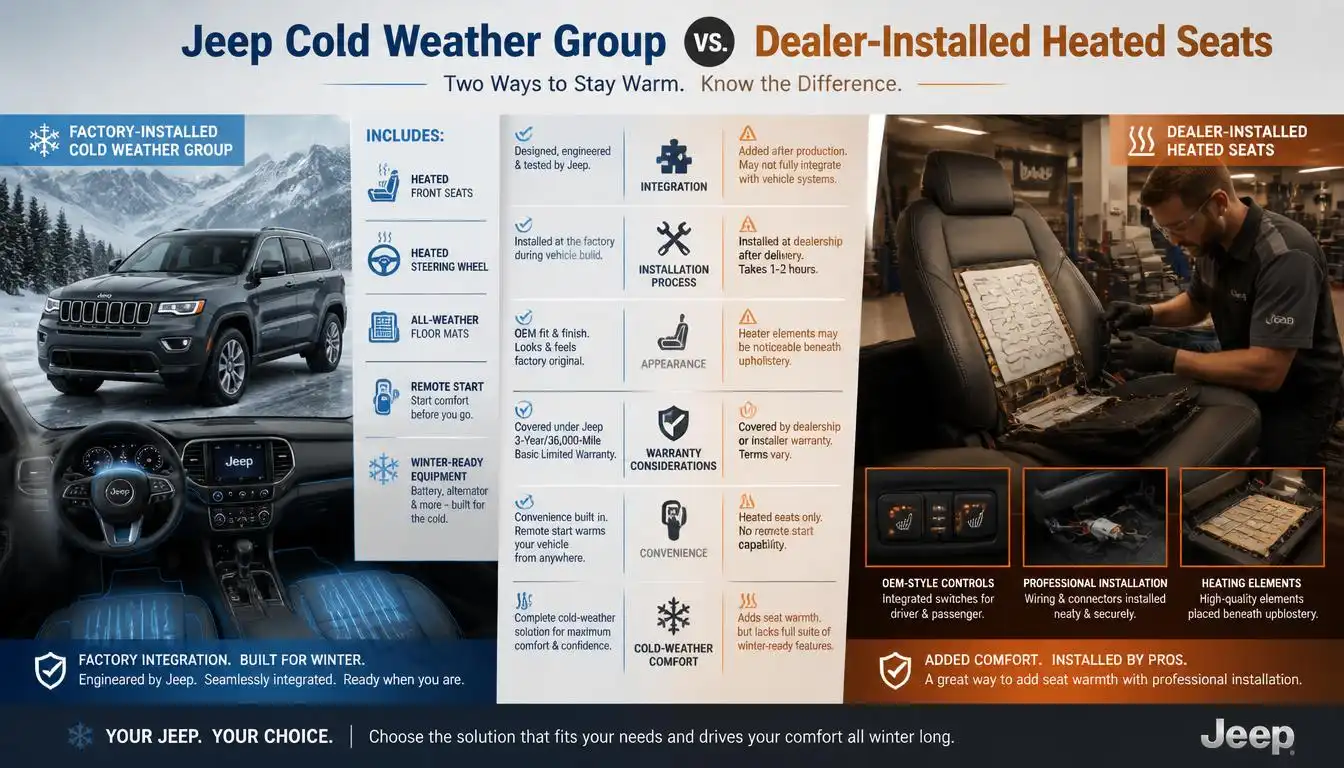
If you are buying a new Jeep, compare the cost of adding heated seats later with getting a factory cold-weather configuration from the start.
Jeep frequently pairs cold-weather comfort features such as:
- Heated front seats
- Heated steering wheel
- Remote start
Exact package names and availability change by model year, trim, and market.
For example, Jeep’s 2026 Wrangler Rewind special edition includes heated front seats, a heated steering wheel, and remote start among its added equipment.
That illustrates an important point: factory cold-weather equipment is often integrated as a group rather than as one isolated seat accessory.
Why Factory Equipment Can Be Better Value
When a Jeep is built with the feature, the wiring, software, controls, modules, and seats are configured for it from the beginning.
Adding those pieces separately later can turn a simple comfort feature into a much larger retrofit.
When a Retrofit Still Makes Sense
You may already own the Jeep you want to keep for years.
In that case, changing vehicles simply to gain heated seats makes little sense.
A professionally installed aftermarket kit can provide most of the comfort at a much lower cost than changing vehicles.
Is It Cheaper to Order Heated Seats From the Factory?
Usually, if you are already ordering a new Jeep, factory-equipped heated seats are the easier choice.
Retrofitting afterward means paying retail prices for individual components plus labor.
For example, Mopar’s current 2026 Wrangler catalog separately lists heating pads and seat-related module kits, demonstrating how quickly a factory-style retrofit can involve multiple components.
That does not mean every factory package is automatically cheap.
You should compare:
- The price difference between the Jeep configurations you are considering.
- The cost of an aftermarket system.
- The dealer’s price for an OEM-style retrofit.
- Whether you actually want the other features included with the factory package.
If you only want warm seats, paying for a larger option package may not always make sense.
Dealer vs OEM Retrofit vs Aftermarket Heated Seats
There is no single best option for every Jeep owner.
| Feature | Factory/OEM Style | Dealer Aftermarket | Independent Aftermarket |
|---|---|---|---|
| Factory appearance | Excellent | Good to very good | Good |
| Cost | Highest in many retrofits | Moderate | Often lowest |
| Factory controls | Possible | Usually no | Usually no |
| Uconnect integration | Possible | Rare | Rare |
| Installation simplicity | Complex retrofit | Moderate | Moderate |
| Parts availability | Vehicle-specific | Broad | Broad |
| Repair options | Dealer/OEM focused | Depends on kit | Often simple |
| Best for | Factory-like result | Convenience | Value |
Which Option Is Cheapest?
A professionally installed aftermarket heating system is generally the least expensive permanent solution.
Which Looks Most Like Factory Equipment?
A properly completed OEM-style installation normally wins.
However, a skilled aftermarket installer can make the heating pads completely invisible. Only the control switch may reveal that the system was added later.
Which Is Easier to Repair?
A simple aftermarket system can sometimes be easier and cheaper to diagnose because it operates independently of the factory infotainment system.
OEM repairs may require vehicle-specific parts and dealer diagnostics.
Jeep Dealer vs Automotive Upholstery Shop
Before paying dealer pricing, get at least one quote from a reputable automotive upholstery specialist.
These businesses regularly remove seat covers, install heating pads, repair foam, and work around seat structures.
A dealer may still be the better choice if you specifically want genuine Mopar components or deeper factory integration.
An upholstery specialist may be better if your priorities are:
- Lower cost
- Clean aftermarket installation
- Fast turnaround
- Multiple heater-kit choices
- Custom switch placement
Do not choose based on price alone.
Ask how many heated-seat installations the shop performs and whether it has experience with your specific Jeep model.
What Affects the Cost of Adding Heated Seats to a Jeep?
Jeep Model and Model Year
A Wrangler and Grand Cherokee do not necessarily use the same seat structure or electronic system.
Even two Wranglers from different generations can require completely different components.
Trim Level
Higher trims may already contain some equipment that lower trims do not.
Never assume the wiring is present because another trim of the same model offers heated seats.
Cloth vs Leather
Heated-seat systems can often be installed under either cloth or leather.
The main issue is whether the seat construction and heater kit are compatible.
The upholstery must be removed and refitted correctly, which is why installer skill matters.
One Seat vs Two Seats
Heating both seats costs more, but doing both at once is often more economical than scheduling two separate jobs.
Existing Wiring
A vehicle already prepared for certain factory equipment may require less work.
One without the necessary wiring can require much more.
Seat Airbags and Occupant Sensors
Modern Jeep seats can contain important safety components.
The passenger seat may include occupant-classification hardware that helps the vehicle determine how its restraint systems should operate.
This is not an area where careless installation is acceptable.
OEM vs Aftermarket Controls
A small aftermarket rocker switch is relatively simple.
Factory-style controls may require additional parts and vehicle integration.
Programming Requirements
Any quote involving factory controls should clearly state whether required programming is included.
Heated Seat Compatibility by Jeep Model
Heated seats can potentially be added to many Jeep models, but compatibility must be checked by model year and trim.
| Jeep Model | Retrofit Potential | Main Issue to Check |
|---|---|---|
| Jeep Wrangler | Good | Wiring, seat electronics, trim |
| Jeep Gladiator | Good | Wrangler-based electrical and seat configuration |
| Jeep Grand Cherokee | Good | Electronics and seat modules |
| Jeep Cherokee | Varies | Model year and available components |
| Jeep Compass | Varies | Seat and electrical compatibility |
| Jeep Renegade | Varies | Wiring and seat construction |
Jeep Wrangler
Wrangler owners have several options, from universal heating pads to more ambitious OEM-style projects.
Because the Wrangler has changed substantially across generations, always identify your exact year and trim before buying anything.
Jeep Gladiator
The Gladiator shares many design elements with the Wrangler, but you should still check the vehicle individually instead of assuming every Wrangler component fits.
Jeep Grand Cherokee
Grand Cherokee models can include more complex seating and comfort electronics, particularly on higher trims.
Professional diagnosis is especially valuable when attempting factory-style integration.
Jeep Cherokee, Compass and Renegade
Aftermarket heating systems may be the simplest solution for these vehicles when a practical permanent heater is more important than factory touchscreen integration.
Will Dealer-Installed Heated Seats Work With Uconnect?
Maybe—but do not assume they will.
A separate aftermarket heater normally has its own physical switch and works independently of Uconnect.
Factory-equipped systems can offer much deeper integration.
For example, Jeep owner documentation describes automatic heated-seat and heated-steering-wheel behavior through comfort settings on appropriately equipped vehicles.
If a dealer tells you the retrofit will operate through the factory touchscreen, ask them to demonstrate exactly how it will work.
Questions to ask include:
- Will the heated-seat icon appear in Uconnect?
- Will all heat levels work?
- Will the physical factory buttons work?
- Is vehicle programming included?
- Will the system operate normally after software updates?
Get those answers before installation.
Can Heated Seats Work With Jeep Remote Start?
Factory-equipped heated seats may interact with remote start.
The 2026 Wrangler owner’s manual states that on applicable equipped hybrid models, remote start can activate heated seats and the heated steering wheel in temperatures below 40°F, or 4.4°C.
That does not mean every aftermarket heated-seat retrofit will automatically do the same thing.
Some aftermarket systems can be connected to remote-start equipment, but extra wiring or integration may be necessary.
For example, one Canadian installer charges separately for heated-seat integration with a remote starter and notes that additional relays or electrical parts may be required depending on the vehicle.
If automatic winter warm-up matters to you, discuss it before choosing the kit.
Should You Add a Heated Steering Wheel at the Same Time?
It is worth considering, particularly if you live somewhere with long winters.
A heated steering wheel can make cold-weather driving noticeably more comfortable because your hands warm up immediately instead of waiting for the cabin heater.
But adding one later can be much more complicated than installing heated-seat pads.
The project may involve a compatible steering wheel, wiring, switches, electronic modules, and vehicle configuration.
Do not assume that adding a heated steering wheel is a cheap extra simply because the seats are already being worked on.
Get a separate price.
Five Ways to Get Heated Seats in a Jeep
1. Buy a Factory-Equipped Jeep
Best for buyers ordering or shopping for a different Jeep.
You get the cleanest integration with the least retrofit work.
2. Complete an OEM-Style Retrofit
Best for owners who strongly prefer a factory appearance and controls.
It can also be the most expensive option.
3. Install Aftermarket Heating Elements
For most existing Jeep owners, this is the practical middle ground.
The heating pads sit underneath the upholstery, so you still use your original seats.
4. Swap to Compatible Factory Heated Seats
Used or replacement OEM seats may appear to be an easy shortcut.
Be careful.
Seat connectors, airbags, occupant sensors, electronics, trim differences, and programming can prevent a simple plug-and-play swap.
Check compatibility before purchasing used seats.
5. Use a Heated Seat Cover
This is the cheapest solution.
A removable heated cover does not offer the clean appearance of a built-in system, but it may be enough if you only need heat occasionally.
It also avoids permanently modifying the seats.
How Long Does Heated Seat Installation Take?
A straightforward aftermarket installation can often be completed within a working day.
OEM-style retrofits can take longer because the dealer may need to:
- Diagnose the vehicle
- Confirm parts compatibility
- Order components
- Remove seats
- Disassemble upholstery
- Install wiring
- Fit modules or controls
- Configure electronics
- Test the complete system
Do not plan around a specific installation time until the shop has inspected your Jeep.
Hidden Costs to Check Before Approving the Dealer Quote
A cheap-looking quote can become expensive when extra charges appear later.
Ask whether the price includes:
- Both front seats
- Bottom and back heating elements
- Wiring
- Relays
- Fuses
- Control switches
- Seat removal
- Upholstery removal and refitting
- Electronic modules
- Diagnostics
- Programming
- Remote-start integration
- Taxes
- Shop supplies
- Warranty
- Replacement clips or upholstery hardware
Ask for the quote in writing.
Will Adding Heated Seats Affect Your Jeep Warranty?
Installing heated seats does not mean you should assume every part of your Jeep immediately loses warranty coverage.
However, warranty coverage for the retrofit itself and for damage related to the modification depends on what parts were installed, who installed them, the terms of your vehicle warranty, and the laws in your country.
Mopar’s US warranty information specifically states that Mopar warranties do not cover non-Mopar parts and do not cover repairs or adjustments required because of the use or installation of non-Mopar equipment.
That is different from saying your entire Jeep warranty automatically disappears.
Before installation, ask:
- Who warranties the heater kit?
- Who covers installation labor?
- How long is coverage?
- What happens if the seat upholstery is damaged?
- What happens if an electrical problem develops later?
- Does the installer document the work?
Because warranty rules differ between the USA, UK, Canada, and Australia, verify the terms that apply to your vehicle and location.
What Happens If a Heated Seat Fails Later?
A heated seat can stop working because of more than one problem.
Possible failures include:
- Damaged heating pad
- Broken wiring
- Loose connector
- Failed switch
- Blown fuse
- Faulty module
- Control or programming problem
A simple aftermarket switch or pad can be relatively straightforward to replace.
A factory-integrated system may require diagnostic testing before anyone knows which component failed.
Keep your installation invoice and warranty documents.
They can save a lot of frustration later.
Do Heated Seats Increase Jeep Resale Value?
Heated seats can make a Jeep more attractive to buyers, especially in colder regions.
A buyer in Minnesota, Alberta, Scotland, or another cold area may see heated seats as a meaningful comfort feature rather than a luxury.
However, do not expect to recover every dollar spent on the installation.
The value depends on:
- Quality of installation
- Condition of the Jeep
- Age and mileage
- Local climate
- Whether the system looks factory installed
- Whether the modification has documentation
- Whether the controls look professional
Think of heated seats primarily as a comfort investment, not a guaranteed profit-making modification.
Heated Seat Installation Costs in the USA, UK, Canada and Australia
Prices vary significantly by country, installer, tax structure, vehicle, and installation type.
The following figures are useful market benchmarks, not guaranteed Jeep dealer prices.
| Country | Current Professional Aftermarket Benchmark | Notes |
|---|---|---|
| USA | About $350–$600 per seat | General professional installation benchmark |
| UK | About £235 + VAT for one, £445 + VAT for two from one specialist | Parts and fitting included |
| Canada | About CAD $499 for one, CAD $849 for two from one Toronto installer | Installed aftermarket system |
| Australia | About AUD $535–$625 for a two-seat ARB kit plus estimated installation | Final vehicle-specific fitment quote required |
United States
Professional aftermarket installation commonly falls around $350–$600 per seat, putting two front seats around $700–$1,200 as a general planning range.
A Jeep dealer attempting an OEM-style installation can charge more because genuine components, diagnostics, modules, programming, and higher dealer labor rates may be involved.
United Kingdom
A UK specialist currently advertises a two-setting heated-seat system at £235 + VAT for one seat or £445 + VAT for two, including parts and labor. A three-setting version is listed at £255 + VAT for one or £495 + VAT for two.
These are independent specialist prices, not official Jeep dealer rates.
Canada
One Toronto installer currently lists CAD $499 installed for one seat and CAD $849 for two.
Canadian Jeep owners should compare that type of quote with their local dealer before choosing an OEM-style retrofit.
Australia
ARB Australia currently lists two-seat heater kits around AUD $295 to $385, with an estimated AUD $240 professional installation option shown on the product pages.
That creates an initial benchmark of approximately AUD $535 to $625, although the final installation price depends on vehicle fitment and the store’s confirmed quote.
Is Jeep Dealer-Installed Heated Seat Installation Worth the Price?
For the right owner, yes.
But the most expensive installation is not automatically the best one.
Dealer Installation Is Worth Considering If You:
- Keep your Jeep for many years
- Drive regularly in freezing weather
- Want genuine Mopar components
- Want the closest possible factory appearance
- Care about factory-control integration
- Prefer having the dealership manage the entire job
- Do not want to modify the seat yourself
Dealer Installation May Not Be Worth It If You:
- Received an unusually high retrofit quote
- Only want basic seat heating
- Do not care about touchscreen integration
- Have access to a reputable upholstery specialist
- Plan to sell the Jeep soon
- Live somewhere heated seats would rarely be used
Best Choice for Budget Buyers
A professionally installed aftermarket heating kit is usually the strongest value.
You get the comfort without trying to recreate every part of the original factory system.
Best Choice for Factory-Like Results
Get an itemized OEM retrofit quote from an authorized Jeep dealer.
Then compare the total with the value of the vehicle.
Spending several thousand dollars to retrofit an older Jeep may not make financial sense simply to gain factory buttons.
Best Choice for a New Jeep Buyer
If heated seats are important to you, look for a Jeep that already has them.
Factory-equipped cold-weather features are generally easier to live with than adding the entire system afterward.
Questions to Ask Your Jeep Dealer Before Paying
Before approving the installation, ask these questions:
- Is this a genuine Mopar/OEM installation or an aftermarket heater kit?
- Does the quote include one seat or both front seats?
- Are both the seat cushion and backrest heated?
- Are parts and labor included?
- Is programming included?
- Will the factory buttons work?
- Will the controls appear in Uconnect?
- Will the heated seats work with remote start?
- Does my Jeep already have the required wiring?
- Will any occupant sensors or seat airbags be disturbed?
- Who is actually performing the installation?
- What warranty covers the parts and labor?
- Are taxes and shop charges included?
- What will replacement parts cost if the system fails later?
The answers will tell you far more than the headline price.
Final Verdict
Jeep dealer-installed heated seats can be worth the price, but you should not approve the job until you know exactly what you are buying.
For most owners of an existing Jeep, a quality professionally installed aftermarket heater offers the best balance of price, warmth, and reliability.
An OEM-style dealer retrofit makes more sense when maintaining a factory appearance and factory-like controls matters more than saving money.
If you are shopping for a new Jeep, buying one that already has heated seats is usually the simplest solution. Factory installation avoids many of the wiring, module, programming, and control issues that can make a later retrofit expensive.
The key is to compare complete installed prices—not just the price of the heating pads.
Get an itemized dealer quote, compare it with a respected automotive upholstery installer, check the warranty, and decide how much factory integration is actually worth to you.
Frequently Asked Questions About Jeep Dealer-Installed Heated Seats Cost
How much does it cost to add heated seats to a Jeep?
Professional aftermarket heated-seat installation in the US commonly costs around $350–$600 per seat, or roughly $700–$1,200 for two seats. An OEM-style Jeep dealer retrofit can cost more because additional Mopar parts, wiring, modules, labor, and programming may be required.
Can a Jeep dealer install heated seats after purchase?
Yes, many dealers can arrange heated-seat installation. The dealer may use genuine components, install an aftermarket system, or work with a specialist installer. Ask what type of system is included in the quote.
Can heated seats be added to a Jeep Wrangler?
Yes, heated seats can often be added to Wranglers. The exact installation method depends on the Wrangler generation, model year, trim, seat design, and electrical configuration.
Can heated seats be added to cloth Jeep seats?
Yes. Many aftermarket heating elements can be installed underneath cloth upholstery when the seat construction is compatible.
Can heated seats be added to leather Jeep seats?
Yes. Heating elements are commonly installed underneath leather seat covers as well. Professional installation is recommended to avoid damaging the upholstery.
Are dealer-installed heated seats the same as factory heated seats?
Not always. A dealer may install an aftermarket heater that uses separate switches. Ask specifically whether the installation recreates the factory system or uses an independent aftermarket kit.
Is the Jeep Cold Weather Group worth it?
For drivers who regularly face cold winters, a factory cold-weather package can offer good value because several useful features may be integrated together. Availability and contents vary by Jeep model, trim, market, and model year.
Are aftermarket heated seats worth it?
They can be. A quality aftermarket system professionally installed beneath the original upholstery can provide excellent warmth for considerably less money than a complex OEM retrofit.
Will aftermarket heated seats void my Jeep warranty?
Do not assume the entire warranty will automatically disappear. However, aftermarket components themselves are not covered by Mopar warranty, and damage caused by non-Mopar equipment or its installation may not be covered. Check your specific warranty and local rules before modifying the vehicle.
Do heated seats work with Jeep remote start?
Factory-equipped systems may work with remote start. Some aftermarket systems can also be integrated, but additional wiring or components may be required. Confirm this before installation.
Can aftermarket heated seats work through Uconnect?
Most independent aftermarket seat heaters use their own switch and do not operate through Uconnect. Factory-style integration is more complex and depends on the Jeep’s hardware and vehicle configuration.
Does a Jeep need programming after adding heated seats?
A basic aftermarket system may not require factory programming. An OEM-style retrofit using factory controls or electronic modules may require additional vehicle configuration.
Can a dealer add a heated steering wheel too?
Possibly, but the heated steering wheel should be treated as a separate retrofit. It can require additional parts, wiring, electronics, and configuration, so ask for a separate compatibility check and quote.
How long does heated seat installation take?
A straightforward aftermarket installation can often be completed within a working day. More complex OEM-style retrofits may take longer because of diagnostics, parts installation, programming, and testing.
Can heated rear seats be added to a Jeep?
It may be possible on some models, particularly with aftermarket heating systems, but rear-seat construction and electrical compatibility need to be checked first.
Do heated seats increase Jeep resale value?
They may improve buyer appeal, especially in cold climates, but you should not expect to recover the full installation cost. Heated seats are better viewed as a comfort improvement than a guaranteed financial return.