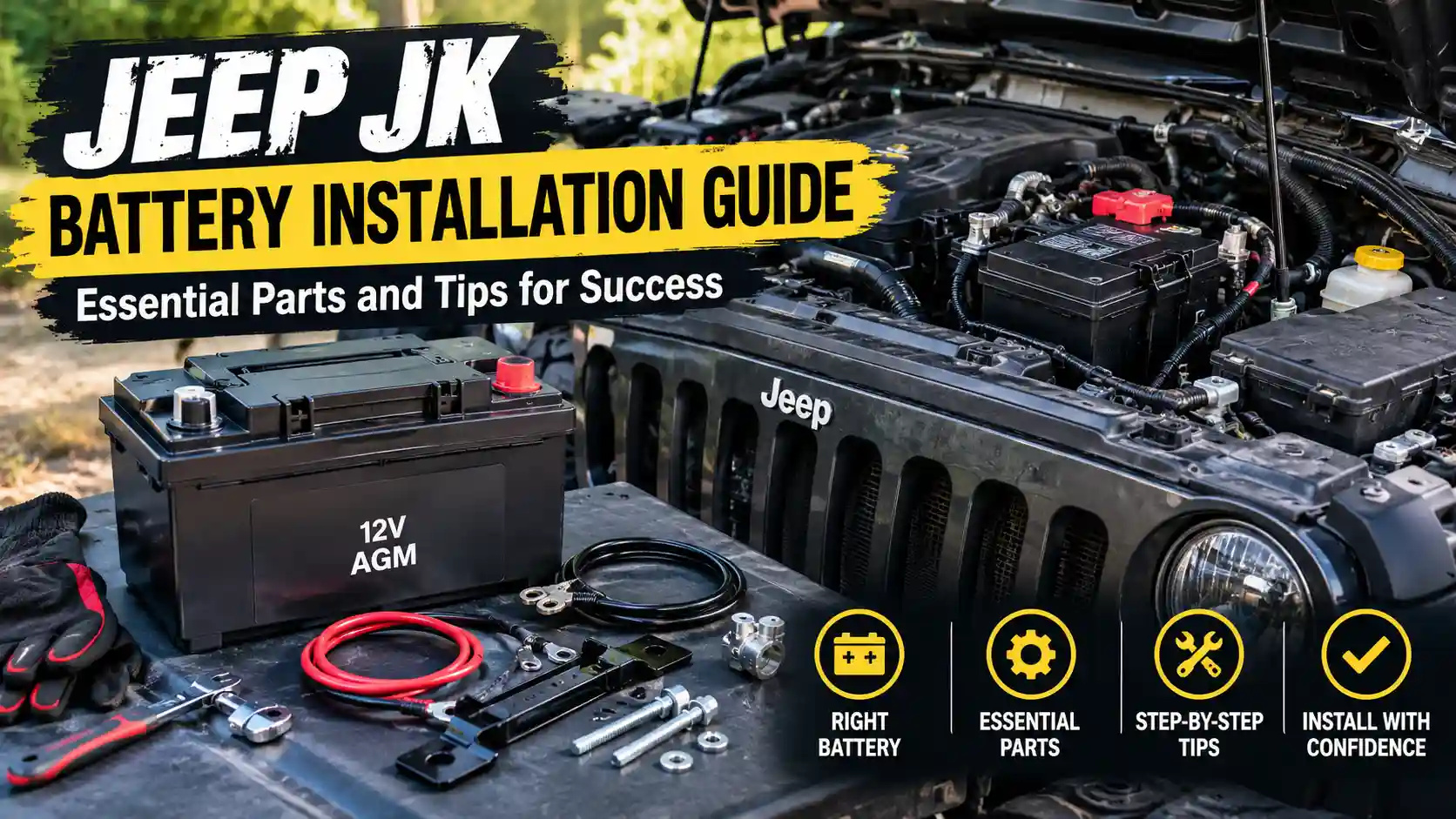
Replacing the battery in a Jeep Wrangler JK is one of those jobs that looks more complicated than it really is. With the right battery, a few basic tools, and the correct terminal order, most owners can handle the replacement at home.
The part that deserves the most attention happens before you loosen the first bolt: choosing the correct battery.
Jeep sold the Wrangler JK from the 2007 model year through 2018, and battery fitment is not identical across the entire generation. Early JKs commonly use a different battery group from later models. Accessories such as winches, auxiliary lights, refrigerators, audio equipment, and other off-road gear can also change what makes sense for your Jeep.
This Jeep JK battery installation guide covers the full job, from choosing the correct battery and testing the old one to removing, installing, checking, and maintaining the new battery.
Quick installation order:
Removing the battery: Negative terminal first, then positive.
Installing the battery: Positive terminal first, then negative.
That order reduces the chance of accidentally creating a short circuit while working around the battery.
What Battery Does a Jeep Wrangler JK Need?
There is no single battery you should automatically buy for every Jeep JK.
Battery group size affects more than capacity. It also determines the physical dimensions of the case, terminal location, and how the battery fits the factory tray and hold-down.
Jeep JK Battery Size by Model Year
The following table is a useful starting point:
| Jeep JK Model Year | Engine | Common Battery Fitment | What to Do Before Buying |
|---|---|---|---|
| 2007–2011 | 3.8L V6 | Group 34 commonly listed | Confirm dimensions and terminal orientation |
| 2012–2017 | 3.6L Pentastar V6 | H6 / Group 48 commonly listed | Verify exact fitment using year, trim, and VIN |
| 2018 JK | 3.6L Pentastar V6 | Fitment can vary by listing/configuration | Make sure you are shopping for a JK, not a JL |
Current fitment catalogs commonly list Group 34 batteries for 2007 and 2011 JK applications and H6/Group 48 batteries for 2012 applications.
Be Careful With the 2018 Wrangler
The 2018 model year deserves extra attention.
Jeep sold the outgoing Wrangler JK alongside the newer Wrangler JL during the 2018 transition. That means searching for a generic “2018 Jeep Wrangler battery” can bring up products intended for the JL rather than the JK.
Jeep even published a separate 2018 Wrangler JK owner’s manual, which makes the generation distinction especially important when ordering parts.
If you own a 2018 model, confirm that your vehicle is actually a JK before buying the battery. Use the VIN, exact trim, existing battery label, or a vehicle-specific parts catalog.
3.8L vs 3.6L Jeep JK Battery Fitment
Jeep JKs can broadly be divided into two engine periods:
- 2007–2011: 3.8L V6
- 2012–2018: 3.6L Pentastar V6
The engine change also lines up with a common change in battery fitment. Early models are frequently listed with Group 34 batteries, while later JKs commonly use the H6/Group 48 family.
Do not choose a battery based only on the words “Jeep Wrangler.” Two batteries may both have enough cranking power but use different case dimensions or terminal positions.
Before ordering, compare the new battery with the existing one and confirm:
- Group size
- Case dimensions
- Positive terminal position
- Negative terminal position
- Battery height
- Hold-down location
- Cable reach
- Cold Cranking Amps
- Reserve capacity
If anything looks different, confirm fitment before installing it.
Understanding Jeep JK Battery Specifications
A battery label contains several numbers, and they are not just marketing terms.
Battery Group Size
The group size describes the physical battery format. It helps determine whether the battery will fit correctly in the tray and whether the terminals will line up with the Jeep’s cables.
A battery that is electrically powerful enough but physically incorrect can still create problems.
Never force the cables to reach a battery whose terminals are in the wrong location.
Cold Cranking Amps
Cold Cranking Amps, or CCA, tell you how well a battery can deliver starting current in cold conditions.
This matters especially for Jeep owners in colder parts of the United States, Canada, and the UK.
If your Jeep regularly sees freezing temperatures, strong cold-start performance should be high on your list.
That does not mean buying the battery with the biggest CCA number you can find. The battery still needs to match the vehicle’s physical and electrical requirements.
Reserve Capacity
Reserve Capacity, usually shown as RC, describes how long a fully charged battery can continue delivering a specified electrical load before its voltage falls too low.
Reserve capacity becomes more relevant when your Jeep runs accessories such as:
- Auxiliary lights
- Communication equipment
- Camping electronics
- Audio amplifiers
- Refrigerators
- Recovery equipment
Amp-Hour Rating
Some batteries also show an amp-hour, or Ah, rating.
This is another way to describe energy capacity. It can be useful when comparing batteries for accessory-heavy Jeeps, but it should not replace proper fitment, CCA, and starting-battery requirements.
AGM vs Flooded Battery for a Jeep JK
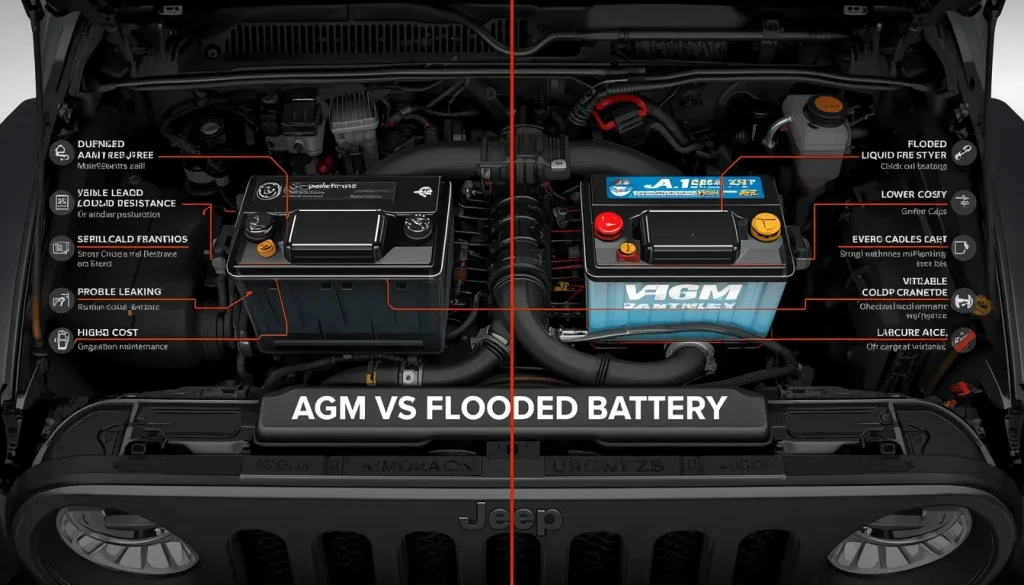
One of the most common decisions JK owners face is whether to buy a traditional flooded lead-acid battery or an AGM battery.
Flooded Battery
A conventional flooded battery is usually the less expensive choice.
It can work perfectly well in a mostly stock Jeep used for normal road driving, provided the battery meets the correct specifications.
Advantages include:
- Lower purchase price
- Wide availability
- Plenty of options
- Suitable for normal starting duty
AGM Battery
AGM stands for Absorbed Glass Mat.
In an AGM battery, the electrolyte is held in fiberglass mats rather than moving freely around the case. This design generally provides better resistance to vibration and reduces the chance of electrolyte movement or leakage.
Those characteristics can be useful in a Jeep that spends time on rough trails. AGM batteries are also popular where the electrical system has to support additional accessories. Interstate notes that AGM construction improves resistance to vibration and extreme conditions compared with conventional designs.
An AGM battery may be worth considering if your JK regularly handles:
- Rough off-road trails
- A winch
- High-output lighting
- Camping equipment
- Heavy audio equipment
- Frequent accessory use with the engine off
The trade-off is price. AGM batteries usually cost more.
For a stock daily driver, a quality flooded battery may be completely adequate. For a heavily equipped trail Jeep, the extra durability of AGM can make more sense.
Before Buying a New Jeep JK Battery, Check These 7 Things
A few minutes of checking can save you from carrying the wrong battery back to the store.
Confirm these seven items:
- Exact model year
- JK rather than JL generation
- Engine
- Battery group size
- Terminal orientation
- CCA and reserve capacity
- Any major electrical accessories
If possible, take a photo of the existing battery label before shopping.
You can also measure the case and compare the positive and negative terminal locations. This is particularly helpful when a Jeep has been modified by a previous owner.
Signs Your Jeep JK Battery May Need Replacement
A battery does not always fail overnight. It often gives you some warning.
Common signs include:
- Engine cranks more slowly than normal
- Rapid clicking when you turn the key
- Headlights appear weak with the engine off
- Jeep needs frequent jump starts
- Electrical accessories behave strangely
- Battery terminals have heavy corrosion
- Battery case is damaged or swollen
- Battery repeatedly loses charge
- Battery is several years old and testing weak
Do not assume every starting problem means the battery is bad.
Loose terminals, damaged ground cables, starter problems, alternator faults, or parasitic electrical drains can create similar symptoms.
Test Your Jeep JK Battery Before Replacing It
If the battery is accessible and safe to inspect, a basic voltage test can tell you a lot.
Check Resting Voltage
Turn the engine off and allow the electrical system to settle.
Set a digital multimeter to DC voltage and place:
- Red probe on the positive terminal
- Black probe on the negative terminal
A healthy, fully charged automotive battery is commonly around 12.6 volts or slightly higher at rest.
Interstate Batteries states that a charged car battery should measure about 12.6 volts or higher.
A lower reading does not automatically mean the battery must be replaced. It may simply be discharged.
Charge it properly and retest if necessary.
Check Charging Voltage
Start the engine and measure again.
The voltage should rise above resting-battery voltage because the alternator is now charging the system.
A commonly seen charging range is roughly 13.7 to 14.7 volts, although the actual reading can vary with temperature, battery condition, alternator control strategy, and electrical load.
If voltage stays unusually low with the engine running, the battery may not be the only problem.
Have the charging system checked.
Get a Load Test When You Are Unsure
A battery can show reasonable voltage and still fail when asked to deliver high current to the starter.
A proper battery load or conductance test gives a better picture of its actual health.
Many battery retailers and repair shops can perform this test quickly.
Essential Parts for Jeep JK Battery Installation
For a normal replacement, you will need the new battery and the existing factory hardware.
However, inspect everything before you begin.
Parts you may need include:
- Correct replacement battery
- Battery hold-down bracket or retainer
- Replacement terminal clamp if damaged
- Battery terminal protector
- Replacement battery cable if badly corroded
- Corrosion-cleaning supplies
Do not reuse a cracked terminal clamp simply because it still seems to tighten.
Poor terminal contact can cause intermittent starting trouble, voltage drop, and heat.
Tools You Will Need
Jeep JK battery replacement requires only basic hand tools.
Useful tools include:
- Ratchet
- Socket set
- Ratchet extension
- Combination wrench
- Battery-terminal brush
- Digital multimeter
- Shop towels
- Protective gloves
- Safety glasses
A 10 mm wrench/socket is commonly used on JK battery terminals and hold-down hardware, although you should confirm the fastener size on your particular Jeep before starting.
Important Battery Safety Rules
Automotive batteries can deliver extremely high current. Lead-acid batteries also contain corrosive electrolyte and can release flammable gas.
Before working:
- Switch the engine off.
- Remove the key.
- Turn off lights and accessories.
- Wear eye protection.
- Wear suitable gloves.
- Keep flames and sparks away.
- Do not smoke near the battery.
- Remove metal jewelry if it could contact electrical parts.
- Never place tools across both battery terminals.
- Keep the battery upright.
- Do not work on a visibly cracked or leaking battery.
If a discharged battery has been exposed to extreme freezing temperatures, be especially careful. Jeep warns that electrolyte in a discharged battery can freeze and that attempting to jump-start a frozen battery can cause it to rupture or explode.
How to Install a Jeep JK Battery Step by Step
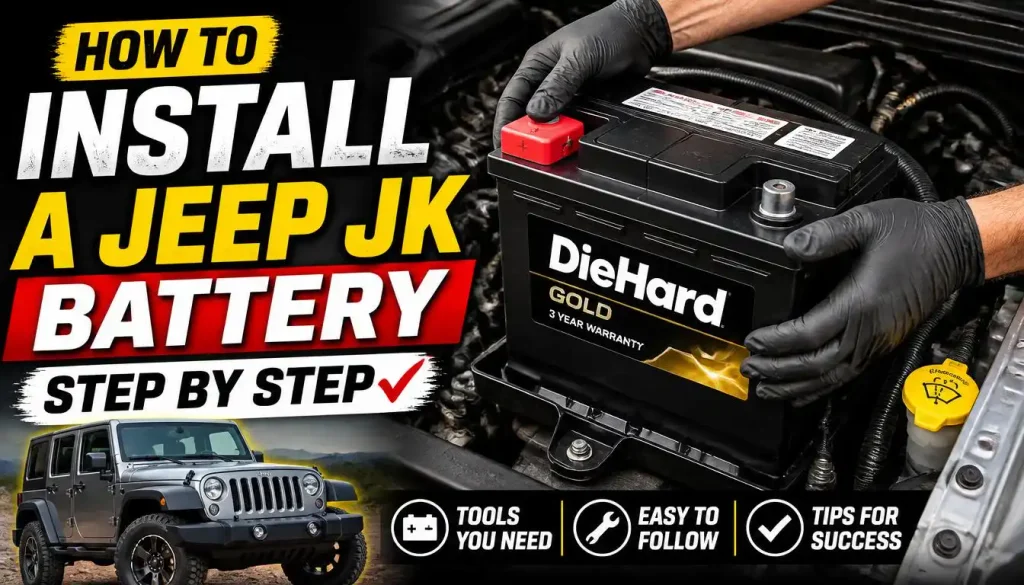
Once you have the correct replacement battery, the actual installation is straightforward.
Step 1: Park the Jeep Safely
Park on firm, level ground.
Shift an automatic transmission into Park or a manual transmission into gear as appropriate, set the parking brake, switch off the ignition, and remove the key.
Turn off:
- Headlights
- Interior lights
- Radio
- HVAC system
- USB accessories
- Aftermarket electronics
Open and securely support the hood.
Step 2: Locate and Inspect the Existing Battery
Before touching anything, look closely at the battery.
Check for:
- Cracks
- Swelling
- Leakage
- Heavy corrosion
- Loose terminals
- Damaged cables
- Extra accessory wires
If the battery case appears seriously damaged, treat it carefully and consider professional removal.
Step 3: Photograph the Connections
This takes ten seconds and can save a lot of confusion later.
Take a clear photo showing:
- Positive cable
- Negative cable
- Accessory cables
- Winch connections
- Lighting wires
- Fuse leads
- Any aftermarket terminals
Modified Jeeps may have several wires attached directly to the battery. A photo gives you a simple reference when reconnecting everything.
Step 4: Disconnect the Negative Terminal First
Locate the negative terminal, normally marked with a minus sign (-).
Loosen the negative terminal clamp.
Lift it away from the battery post and position it where it cannot accidentally spring back into contact.
Always disconnect the negative cable before the positive cable during normal battery removal.
Why?
The vehicle body and engine are connected to the negative side of the electrical system. Disconnecting the negative cable first reduces the chance that a wrench touching body metal while working on the positive terminal will complete a dangerous short circuit.
Step 5: Disconnect the Positive Terminal
Now loosen and remove the positive terminal.
The positive side is normally marked with a plus sign (+) and often has red identification.
Keep the positive cable away from the battery post.
Step 6: Remove Accessory Connections Carefully
If your Jeep has extra wires for a winch, lights, amplifier, air compressor, or other equipment, remove them carefully.
Keep track of where each connection belongs.
Do not assume every red wire belongs directly on the battery without checking your earlier photo.
Step 7: Remove the Battery Hold-Down
The battery must be mechanically secured to the tray.
Use your ratchet, extension, and appropriate socket to remove the retaining bracket or hold-down.
Place the hardware somewhere safe.
If the bolt is badly rusted, work carefully rather than forcing it until it snaps.
Step 8: Lift the Old Battery Out
Automotive batteries are heavier than they look.
Use both hands and keep the battery upright as you lift it from the tray.
If the battery is too heavy to lift safely, get help.
Do not pull the battery out by its cables or terminals.
Step 9: Inspect and Clean the Battery Tray
With the battery removed, this is the best time to inspect the tray.
Look for:
- Dirt
- Rust
- Corrosion
- Broken mounting points
- Loose hardware
- Damage from an unsecured battery
Clean away dirt and corrosion before installing the replacement.
A clean tray lets the battery sit flat and makes future inspection easier.
Step 10: Clean the Cable Terminals
Examine the inside surfaces of both terminal clamps.
Corrosion increases electrical resistance.
Use a battery-terminal cleaning tool to clean the contact surfaces when necessary.
If a clamp is badly stretched, cracked, or damaged, replace it rather than trying to compensate by overtightening it.
Step 11: Place the New Battery in the Tray
Lower the replacement battery carefully into position.
Before securing it, confirm that:
- Battery sits flat
- Positive terminal is on the correct side
- Negative terminal is on the correct side
- Cables reach naturally
- Cables are not stretched
- Battery case does not contact anything sharp
- Hold-down lines up correctly
If the cables only reach when pulled tight, stop.
That is a strong sign that the battery orientation or fitment may be wrong.
Step 12: Reinstall the Battery Hold-Down
Reinstall the factory retaining bracket.
The battery should not slide, rock, or bounce in the tray.
This matters on any vehicle, but it is especially important on a Jeep that may see washboard roads, rocks, ruts, and sudden changes in angle.
Do not crush or deform the battery case by excessively tightening the hold-down.
Step 13: Connect the Positive Terminal First
Place the positive cable clamp over the positive battery post.
Make sure it is fully seated.
Tighten it securely.
Do not overtighten the clamp in an attempt to solve a poor fit.
A properly fitted terminal should stay firmly in place and should not rotate freely by hand.
Step 14: Connect the Negative Terminal Last
Once the positive connection is complete, install the negative cable.
This gives you the correct installation sequence:
Positive first → Negative last.
Current general Jeep battery-replacement guidance follows this same reconnection order.
Step 15: Reconnect Aftermarket Accessories
Use your photo as a reference.
Reconnect accessory leads to the same locations they used before removal.
Pay particular attention to:
- Polarity
- Fuse location
- Cable routing
- Terminal stacking
- Cable clearance
A high-current accessory such as a winch should have correctly sized, properly protected wiring according to the equipment manufacturer’s instructions.
Step 16: Perform a Final Physical Check
Before starting the engine, check the installation by hand.
Confirm:
- Battery does not move
- Positive terminal is secure
- Negative terminal is secure
- No loose tools remain in the engine bay
- No cable is trapped under the battery
- Cables are away from belts and moving parts
- Positive terminal is protected from accidental contact where applicable
Then start the Jeep.
What to Check After Installing the New Battery
A successful engine start does not mean you should immediately close the hood and walk away.
Spend another minute checking the system.
Listen to the Starter
The starter should crank confidently.
If it still sounds slow, check the cable connections and battery condition.
Check the Dashboard
Look for unexpected warning lights.
A battery or charging-system warning that stays illuminated deserves further diagnosis.
Measure Charging Voltage
If you have a multimeter, check the voltage with the engine running.
You should normally see a reading clearly above resting voltage.
If the charging voltage remains low, investigate the alternator, wiring, grounds, and charging system rather than repeatedly replacing batteries.
Check Your Accessories
Test the equipment that was disconnected.
That may include:
- Radio
- Lights
- Winch control
- Audio system
- Compressor
- Auxiliary switches
Make sure nothing was accidentally left disconnected.
Correct Jeep JK Battery Terminal Order
This is worth remembering because it applies every time you replace the battery.
| Task | First | Second |
|---|---|---|
| Battery removal | Negative (-) | Positive (+) |
| Battery installation | Positive (+) | Negative (-) |
A simple memory trick is:
Negative leaves first and comes back last.
How Tight Should Jeep JK Battery Terminals Be?
Battery terminals should be tight enough that they cannot move freely on the posts.
They should not need extreme force.
Overtightening can:
- Damage the terminal clamp
- Distort soft lead components
- Damage hardware
- Make future removal difficult
If a terminal remains loose after normal tightening, inspect the clamp.
The correct repair is not always “tighten it harder.” A stretched or damaged clamp may need replacement.
For an exact torque value, use the service information for your specific model year and terminal hardware rather than relying on a universal number.
Common Jeep JK Battery Installation Mistakes
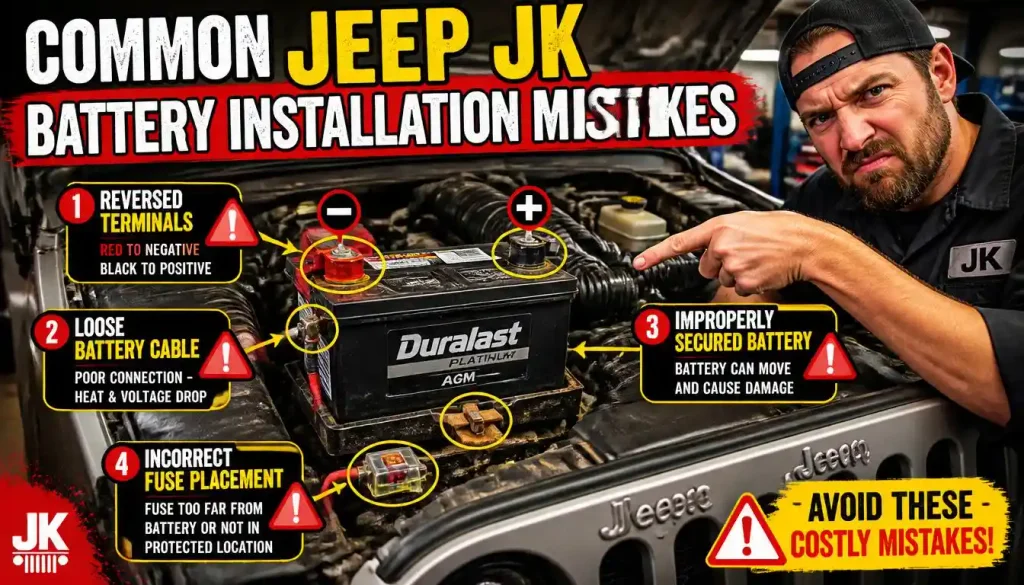
Most battery replacement problems come from a few simple mistakes.
Buying the Wrong Battery Group
The battery may look close enough but still be too tall, too wide, or have terminals in the wrong location.
Always verify fitment before installation.
Confusing a 2018 JK With a 2018 JL
This can lead to incorrect battery recommendations because the two generations use different electrical configurations.
Shop using the exact generation.
Removing the Positive Terminal First
The normal safe removal sequence starts with the negative terminal.
Reversing Battery Polarity
Never connect positive and negative backward.
Double-check the symbols molded or printed on the battery before connecting either cable.
Leaving the Battery Loose
A loose battery can shift during braking, cornering, or off-road driving.
Always reinstall the hold-down.
Overtightening the Terminals
More force is not always better.
A damaged clamp should be repaired or replaced.
Ignoring Corroded Cables
A new battery cannot compensate for a poor electrical connection.
Clean or repair badly corroded cable ends and grounds.
Forgetting Accessory Wires
Modified Jeeps often have extra leads attached to the battery.
Photograph everything before disassembly.
Letting a Tool Bridge Electrical Connections
Never allow a wrench or other metal object to contact both battery terminals or bridge an energized positive terminal to grounded metal.
New Battery Installed but Jeep JK Won’t Start
If the Jeep will not start after replacement, do not immediately assume the new battery is faulty.
Work through the basics first.
Check Both Battery Terminals
Try to move each clamp by hand.
A connection can look installed but still be loose enough to prevent adequate starter current.
Confirm Polarity
Make absolutely sure:
- Positive cable is on positive
- Negative cable is on negative
If polarity was accidentally reversed, stop and inspect the electrical system before continuing.
Test Battery Voltage
A new battery is not always fully charged.
Measure resting voltage.
If the battery is discharged, charge and test it properly.
Inspect Ground Connections
The negative cable must have a clean, low-resistance connection to the vehicle.
Check visible ground connections for:
- Corrosion
- Loose hardware
- Broken cable strands
- Previous modifications
Check Main Fuses
An electrical fault during installation can damage a fuse or fusible protection device.
Check the appropriate fuse locations using the owner’s manual.
Check the Starter
If battery voltage and connections are good but the engine does not crank, the starter or starter-control circuit may need diagnosis.
Jeep JK Starts but the Battery Light Stays On
A battery warning light usually relates to the charging system, not simply the age of the battery.
Possible causes include:
- Alternator problem
- Loose electrical connection
- Damaged charging cable
- Ground problem
- Drive-belt issue
- Charging-system fault
If the warning stays on, check charging voltage and diagnose the system before driving far.
Why Does a New Jeep JK Battery Keep Dying?
Installing a fresh battery will not fix an electrical drain.
If the battery repeatedly goes flat, consider:
- Light left on
- Aftermarket accessory wired incorrectly
- Audio amplifier staying awake
- Dash camera drawing power
- Communication equipment
- Faulty relay
- Charging-system problem
- Corroded electrical connections
- Parasitic current draw
Do not keep replacing batteries without finding the cause.
A parasitic-draw test can help identify a circuit that continues consuming excessive power after the Jeep is switched off.
Jeep JK Battery Tips for Winches and Off-Road Accessories
A stock JK and a heavily modified overland Jeep place very different demands on a battery.
Winch Use
Electric winches can draw a very large amount of current.
Your battery needs to be healthy, but the charging system, cable size, grounds, connection quality, and winching technique matter just as much.
Do not assume installing the highest-CCA battery automatically solves every winch-power problem.
Auxiliary Lighting
LED lighting may be efficient, but several light bars and pods can still create meaningful electrical load.
Use correctly rated relays, fuses, and wiring.
Camping Electronics
A refrigerator, inverter, camp lighting, and device charging can drain a starting battery when the engine is off.
If you camp regularly, consider how much energy your accessories use and whether a properly designed dual-battery or auxiliary-power system would better suit your needs.
When a Dual-Battery System Makes Sense
A dual-battery setup may be useful for an owner who frequently runs substantial equipment with the engine off.
Examples include:
- Overland refrigeration
- Camping lighting
- Communication equipment
- Inverters
- Extended accessory use
A dual-battery system should be designed correctly. Adding another battery without proper isolation, charging control, cable protection, and mounting can create more problems than it solves.
How Long Does a Jeep JK Battery Last?
Many automotive batteries provide roughly three to five years of service under normal conditions, although actual life can be shorter or longer. AutoZone gives the same general three-to-five-year range for Wrangler batteries.
Battery life depends heavily on climate and usage.
Cold Climates
Owners in Canada, northern parts of the USA, and colder UK regions may notice weak batteries during winter because low temperatures make starting more demanding.
Cold-weather CCA performance becomes especially important.
Hot Climates
High temperatures can also shorten battery life by accelerating internal chemical deterioration.
That matters in hot areas of the United States and Australia.
Short Trips
Repeated short drives may not give the charging system enough time to restore the energy used during starting.
Long-Term Storage
A Jeep left unused for weeks or months can gradually discharge.
A compatible smart battery maintainer can be useful during long storage periods.
Jeep JK Battery Maintenance Tips
A little maintenance can prevent many starting problems.
Keep the Top of the Battery Clean
Dirt and moisture around terminals make inspection harder and may contribute to corrosion.
Inspect Terminals Regularly
Check for:
- White or blue-green deposits
- Loose clamps
- Cracked terminals
- Frayed cables
Keep the Battery Secure
Check the hold-down occasionally, especially after rough off-road trips.
Watch Accessory Wiring
Added electrical equipment is a common source of trouble on modified vehicles.
Look for:
- Unprotected positive cables
- Poor crimps
- Missing fuses
- Loose grounds
- Wires rubbing on metal
Test Before Extreme Weather
Testing a marginal battery before winter or a long summer road trip is much easier than dealing with a no-start far from home.
Jeep JK Battery Replacement Cost
The total cost depends mainly on the battery you choose.
Factors include:
- Battery group size
- Flooded or AGM design
- CCA rating
- Warranty length
- Brand
- Country
- Retailer
- Professional labor
A basic flooded battery will generally cost less than a premium AGM model.
DIY installation can eliminate labor cost, while professional installation may be worthwhile if the Jeep has significant corrosion, damaged cables, complex accessory wiring, or charging-system problems.
Prices also differ substantially between the USA, UK, Canada, and Australia, so local fitment and current retailer pricing are more useful than relying on one universal price.
DIY vs Professional Jeep JK Battery Installation
| Factor | DIY Replacement | Professional Replacement |
|---|---|---|
| Labor cost | Low or none | Additional cost possible |
| Tools required | Yes | No |
| Installation control | High | Technician handles it |
| Best for | Simple battery replacement | Electrical or fitment problems |
| Diagnostic support | Limited | Usually better |
| Accessory-heavy Jeep | Requires extra care | Often easier professionally |
If the battery simply reached the end of its life and the cables are clean, replacement is a reasonable DIY job.
Professional help makes more sense when:
- Battery keeps dying
- Charging voltage is abnormal
- Cables are badly corroded
- Terminals are damaged
- Wiring has been heavily modified
- Jeep still will not start with a known-good battery
What Happens After Disconnecting a Jeep JK Battery?
Disconnecting power may cause some stored settings or learned values to reset.
You may notice things such as:
- Clock needs adjustment
- Certain stored preferences need resetting
- Engine behavior briefly feels slightly different while systems readapt
Do not perform improvised ECU-reset procedures, short battery cables together, or intentionally bridge electrical connections just because you replaced the battery.
For a normal battery replacement, reconnect the battery correctly, start the vehicle, check for warnings, and follow the owner’s or service manual if a specific issue appears.
Does a Jeep JK Need Battery Registration?
A normal Wrangler JK battery replacement is not typically treated like the battery-registration procedures required by some vehicles with dedicated battery-management systems.
The important tasks are selecting the correct battery specification, installing it with the correct polarity, securing it properly, and checking the charging system afterward.
If your Jeep has non-factory electrical equipment or a modified charging system, follow the instructions for those components as well.
How to Dispose of an Old Jeep JK Battery
Never place a lead-acid automotive battery in normal household trash.
Automotive batteries contain materials that should be recycled through an approved collection system.
Depending on where you live, you may be able to return the old battery to:
- Battery retailer
- Auto-parts store
- Recycling center
- Garage
- Municipal hazardous-waste facility
Some retailers use a core-charge system where part of the purchase cost is refunded when the old battery is returned.
Local recycling rules differ across the USA, UK, Canada, and Australia, so use the approved system in your area.
Frequently Asked Questions About Jeep JK Battery Installation
What size battery does a Jeep JK use?
Battery size depends on model year and configuration. 2007–2011 JKs are commonly listed with Group 34 batteries, while 2012–2017 JKs commonly use H6/Group 48 fitments. Verify the exact vehicle before buying. 2018 requires extra care because both JK and JL Wranglers exist for that model year.
What battery does a 2007 Jeep Wrangler JK use?
Group 34 is a commonly listed battery fitment for the 2007 Wrangler. Current parts catalogs show both flooded and AGM Group 34 options for that application.
What battery does a 2012 Jeep Wrangler JK use?
H6/Group 48 is commonly listed for the 2012 Wrangler. Verify your specific vehicle before ordering because battery catalogs can include multiple products and configurations.
Which battery terminal do I disconnect first on a Jeep JK?
Disconnect the negative terminal first, followed by the positive terminal.
Which terminal should I connect first when installing the battery?
Connect the positive terminal first, then connect the negative terminal last.
Can I replace a Jeep JK battery myself?
Yes. For a straightforward replacement with clean factory wiring, it is a manageable DIY job with basic hand tools. If there is severe corrosion, damaged wiring, charging-system trouble, or complicated aftermarket equipment, professional help may be a better choice.
How long does Jeep JK battery replacement take?
For an experienced DIYer working on a clean, mostly stock Jeep, the actual replacement can be relatively quick. Allow more time if terminals are corroded, the hold-down is rusty, or numerous accessory wires are attached.
Is AGM better for a Jeep JK?
AGM can be a good choice for Jeeps exposed to frequent vibration, off-road use, or heavier electrical demands. A quality flooded battery can still be suitable for a mostly stock daily-driven JK.
How many volts should a Jeep JK battery have?
A fully charged 12-volt automotive battery commonly reads around 12.6 volts or slightly higher at rest. With the engine running, charging voltage is commonly in the area of 13.7 to 14.7 volts, though the exact reading can vary.
How many CCA does a Jeep JK need?
There is no single CCA number that should be applied to every JK. Match or exceed the appropriate specification for your model year while using the correct battery group and physical fitment. Cold-climate drivers may benefit from stronger cold-cranking performance.
Why won’t my Jeep JK start after installing a new battery?
Check terminal tightness, polarity, battery charge, grounds, fuses, and starter operation. If those are good, test the charging and starting systems.
Why does my new Jeep JK battery keep dying?
A new battery that repeatedly discharges can indicate a parasitic electrical draw, alternator problem, poor connection, or aftermarket accessory that remains powered when the Jeep is off.
Can a loose Jeep JK battery terminal cause starting problems?
Yes. A loose connection can prevent enough current from reaching the starter even when the battery itself is healthy.
How often should I replace my Jeep JK battery?
There is no fixed replacement date for every vehicle. Many automotive batteries last around three to five years, but temperature, driving pattern, storage, accessory use, and charging-system condition can change that significantly. Testing the battery is more useful than replacing it solely because of age.
Do I need a dual battery for a winch?
Not necessarily. Many Jeeps operate winches with a properly sized, healthy starting battery and charging system. A dual-battery system becomes more useful when you also want extended accessory power with the engine off or need a separate reserve power source.
Should I reset the ECU after changing the battery?
Normally, you do not need to perform a special DIY ECU reset simply because the battery was replaced. Start the Jeep, let the systems operate normally, and investigate only if a warning or drivability issue remains.
Final Jeep JK Battery Installation Checklist
Before closing the hood, run through this list:
- Correct JK model year confirmed
- JK vs JL verified if vehicle is a 2018
- Correct battery group size installed
- Correct terminal orientation confirmed
- Battery sitting flat in the tray
- Battery hold-down securely installed
- Positive cable connected correctly
- Negative cable connected correctly
- Terminals cannot rotate by hand
- Accessory wires returned to correct positions
- Cables kept away from moving parts
- No tools left in engine bay
- Jeep starts normally
- Charging voltage checked if possible
- No unexpected warning lights remain
Final Thoughts
A successful Jeep JK battery installation depends on three things: correct fitment, correct connection order, and secure installation.
Do not rush the battery-selection step. Early and late JK models do not all use the same common battery group, and the 2018 model year can be especially confusing because JK and JL Wranglers overlap.
Once you have the correct battery, the physical replacement is simple. Disconnect the negative terminal first, remove the positive, secure the new battery properly, then reconnect the positive before the negative.
Take an extra minute to clean the connections and test the charging system afterward. That small amount of care can prevent loose-terminal problems, repeat dead batteries, and frustrating no-start situations later.
For a stock or lightly modified Wrangler, that is usually all the job requires. If your JK has a winch, auxiliary lighting, camping equipment, or extensive electrical modifications, treat the battery as part of the complete charging system rather than as an isolated component.