Replacing a crank pulley on a Jeep can look like a straightforward remove-and-replace job, but it becomes difficult quickly if you do not have the correct puller, installer, sockets, or information for your specific engine.
If you searched for a Jeep Innovators crank pulley install, you are probably trying to find the easiest way to remove an old crank pulley or harmonic balancer and install the replacement without damaging the crankshaft, pulley, or threads.
The most important rule is simple: identify your Jeep’s exact year, model, and engine before choosing tools or torque specifications. Jeep applications use different crankshaft dampers, bolts, puller designs, and installation procedures. Mopar itself lists different crankshaft damper assemblies according to specific engines and vehicle applications.
This guide explains the tools you may need, how the replacement process generally works, common problems to avoid, and how to check your work before putting your Jeep back on the road.
Quick Answer: What Do You Need to Install a Jeep Crank Pulley?
For most Jeep crank pulley or harmonic balancer replacement jobs, you will need:
- Correct replacement crank pulley or harmonic balancer
- Harmonic balancer or crank pulley puller
- Harmonic balancer installation tool
- Socket and ratchet set
- Breaker bar
- Torque wrench
- Serpentine belt tool or suitable wrench
- Crankshaft or harmonic balancer holding tool when required
- Basic hand tools
- Safety glasses
- Mechanic gloves
- Vehicle-specific service information
Do not buy a puller or installer simply because the package says “universal.” Verify that its adapters and puller design work with your Jeep engine first.
Professional tool manufacturers sell different harmonic balancer pullers, holding tools, and multi-adapter installation kits because crankshaft and pulley designs are not identical across engines. For example, OTC offers Chrysler-specific balancer removal and holding equipment, while Lisle offers installer kits with multiple threaded adapters.
What Is a Jeep Crank Pulley?
The crank pulley sits at the front of the engine and rotates with the crankshaft. The serpentine belt runs around this pulley and transfers power to belt-driven accessories.
Depending on the Jeep engine and the terminology being used, you may also see the assembly described as a:
- Harmonic balancer
- Crankshaft damper
- Vibration damper
- Crankshaft pulley
- Damper pulley
These terms are often used interchangeably in parts listings and repair discussions, although the exact design depends on the engine.
A crankshaft damper does more than provide a belt-running surface. Its job can also include reducing crankshaft vibration. Mopar describes its crankshaft damper as a component designed to absorb and reduce harmful crankshaft vibrations.
That is why a damaged damper should not be treated like a harmless cosmetic pulley problem.
Crank Pulley vs Harmonic Balancer: Are They the Same?
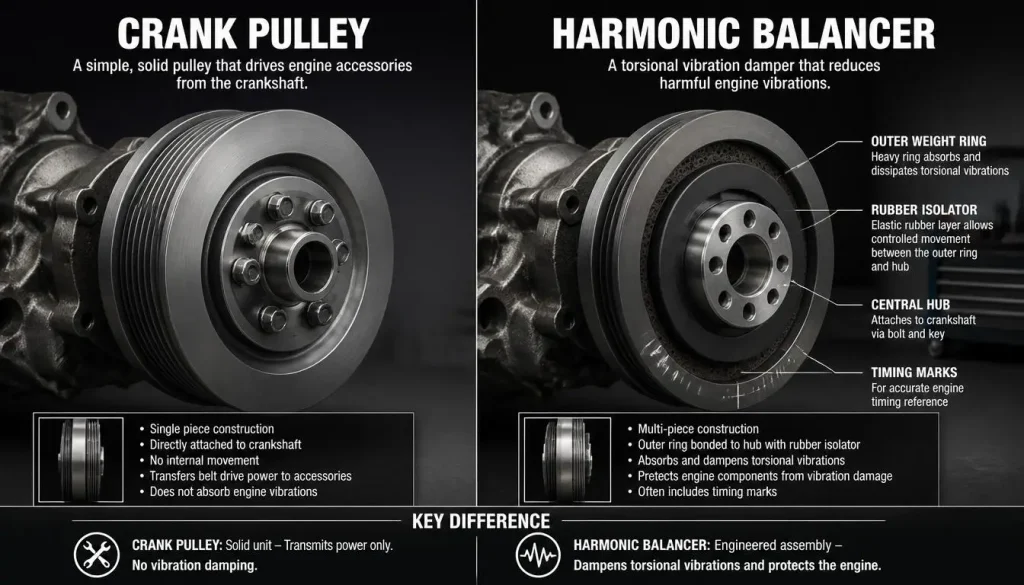
On many Jeep applications, the accessory-drive pulley and vibration-damping assembly are part of the same overall component.
This is why someone searching for a Jeep crank pulley replacement may find parts sold as a harmonic balancer or crankshaft damper instead.
Before ordering anything, compare:
- Vehicle year
- Jeep model
- Engine displacement
- Original part number when available
- Pulley diameter
- Belt groove design
- Offset
- Crankshaft mounting design
Do not rely on appearance alone. Two pulleys can look similar while having different dimensions or fitment.
Signs Your Jeep Crank Pulley May Need Replacement
A failing crank pulley or harmonic balancer can show several warning signs.
Visible Pulley Wobble
Look at the pulley while the engine is running from a safe distance. It should rotate consistently.
A noticeable side-to-side wobble deserves investigation. Do not put your hands, clothing, tools, or phone close to a moving belt or pulley.
Cracked or Separated Rubber
Many dampers use rubber between sections of the assembly.
If the rubber is badly cracked, bulging, displaced, or separating, the pulley may no longer remain correctly aligned.
Serpentine Belt Misalignment
A damaged or incorrectly positioned pulley can affect belt tracking.
Look for:
- Belt moving toward the edge of a pulley
- Fraying
- Unusual belt dust
- Repeated belt throwing
- Uneven belt wear
Unusual Vibration
New vibration from the front of the engine should not automatically be blamed on the crank pulley, but a deteriorated damper should be part of the inspection.
Other causes can include engine mounts, accessory bearings, belt tensioners, or internal engine problems.
Squealing or Chirping
A squeal or chirp can come from belt misalignment, worn belt material, contaminated pulleys, tensioner problems, or accessory bearings.
Inspect the complete belt drive rather than replacing the crank pulley based on noise alone.
Tools Needed for a Jeep Crank Pulley Installation
Having the correct tools can make the difference between a controlled repair and a frustrating afternoon.
Socket and Ratchet Set
You will need sockets for surrounding components and the crankshaft bolt.
The crank bolt size is not universal across every Jeep engine, so verify the correct socket before beginning.
A six-point socket is often preferable for high-load fasteners because it provides solid contact with the bolt head.
Breaker Bar
Crankshaft bolts can be extremely tight.
A long breaker bar gives you more leverage than a standard ratchet.
Never extend a tool with random pipe unless the tool manufacturer specifically permits that use. Excess leverage can break sockets or bars and cause injury.
Torque Wrench
A torque wrench is essential for final assembly when the service procedure specifies a particular torque or torque-plus-angle sequence.
Do not copy a crankshaft bolt specification from another Jeep simply because it uses a similar-looking pulley.
The correct specification should match your:
year + model + engine + fastener procedure.
Serpentine Belt Tool
The serpentine belt must normally be released before the crank pulley can be removed.
Depending on the Jeep, access may be easier with:
- Long serpentine belt tool
- Ratchet
- Breaker bar
- Appropriate wrench
Take a photo of the belt routing before removing it if the routing diagram is missing or difficult to read.
Harmonic Balancer Puller
A proper harmonic balancer puller removes a press-fitted pulley or damper without relying on uncontrolled hammering or prying.
Lisle specifically describes its harmonic balancer puller as a tool designed to make pulley removal easier while reducing damage to the pulley and shaft.
That is exactly why the correct puller is worth using.
Harmonic Balancer Installer
Removal is only half the job.
A harmonic balancer installer uses a threaded adapter and controlled force to draw the new balancer onto the crankshaft.
Lisle’s installer kits, for example, use a driving screw, thrust bearing, and multiple threaded adapters to handle different applications.
The important point is not the brand of tool. It is choosing an installer that matches your crankshaft threads and provides enough reach.
Harmonic Balancer Holding Tool
On some engines, you need a way to keep the pulley from rotating while loosening or tightening the crankshaft bolt.
OTC offers a Chrysler harmonic balancer puller set that includes both a puller and a holding tool designed for crankshaft bolt service.
Never improvise by wedging fragile engine parts unless the correct service procedure specifically calls for it.
Which Crank Pulley Tool Fits Your Jeep?
This is one of the most important parts of the entire job.
A tool that works perfectly on one Jeep engine may be useless on another.
Before buying or renting a tool, check four things.
Jeep Engine Size
Identify the exact engine first.
Common Jeep engines include, among many others:
- 2.5L
- 3.6L Pentastar
- 3.7L
- 3.8L
- 4.0L
- 4.7L
- 5.7L HEMI
- 6.4L HEMI
That does not mean every version of those engines uses the same balancer or tool.
Mopar parts catalogs separate crankshaft and damper components by vehicle and engine application, reinforcing why fitment should be confirmed rather than assumed.
Puller Design
Inspect how the pulley is designed to be removed.
A puller may use:
- Bolts threaded into the pulley
- Puller jaws
- Special clips
- Engine-specific adapters
Do not hook an ordinary jaw puller around a delicate outer ring unless the tool and pulley design specifically support that method.
Installer Thread Compatibility
The installer threads into the crankshaft.
If its adapter has the wrong thread pitch or diameter, do not force it.
Cross-threading the crankshaft can turn an inexpensive repair into a major engine problem.
Installer Reach
Some dampers sit deeply enough that a short installer cannot engage the crankshaft properly.
That is why professional installer kits may include long adapters and spacers for deeper applications.
Jeep Crank Pulley Tool Compatibility by Engine
Instead of assuming one tool works everywhere, use this as a pre-repair checklist.
| Engine Type | What You Should Verify |
|---|---|
| Jeep 2.5L | Puller design, crank threads, pulley fitment |
| Jeep 3.6L Pentastar | Puller type, holding method, installer compatibility |
| Jeep 3.7L | Crank bolt, puller design, installer thread |
| Jeep 3.8L | Balancer design, access, tool adapters |
| Jeep 4.0L | Pulley configuration, crank threads, puller attachment |
| Jeep 4.7L | Puller compatibility, installer reach |
| Jeep 5.7L HEMI | Installer reach, puller type, holding method |
| Jeep 6.4L HEMI | Damper fitment, installer and service procedure |
Use this table as a list of items to verify, not as a universal specification chart.
Can You Rent a Jeep Crank Pulley Tool Instead of Buying One?
For a one-time repair, renting or borrowing a specialty tool can make more sense than purchasing an expensive professional kit.
Before renting, take your vehicle information with you:
- Year
- Make
- Model
- Engine
- Replacement pulley information
Then confirm that the kit includes both the correct removal attachment and installer adapter.
Do not assume a “harmonic balancer kit” includes everything needed for installation. Some kits are pullers only.
If you maintain several vehicles or regularly work on Jeeps, owning a quality multi-adapter kit may be more convenient.
How to Choose the Right Harmonic Balancer Puller for a Jeep
Choosing the wrong puller can damage the pulley before it moves.
Check for Puller Attachment Points
Look carefully at the original balancer.
If it has dedicated puller attachment points, use the tool configuration intended for them.
Avoid Pulling on Weak Areas
The outer section of some harmonic balancers is isolated from the hub by damping material.
Applying excessive pulling force to the wrong area can damage the assembly instead of removing it cleanly.
Consider Engine-Bay Clearance
A tool that fits the pulley may still be unusable if it is too long for the available space.
Check clearance around:
- Radiator
- Cooling fan
- Fan shroud
- Crossmembers
- Other front-engine components
Some vehicles require additional parts to be removed simply to create enough working room.
Harmonic Balancer Installer Thread Size Explained
One of the easiest mistakes is assuming every balancer installer uses the same crankshaft adapter.
They do not.
Multi-application kits exist because crankshafts use different thread sizes. Lisle’s current installer kit includes 13 threaded adapters and several long adapters for different applications.
Before threading an installer into your Jeep crankshaft:
- Clean the crankshaft threads.
- Inspect them with a light.
- Identify the correct adapter.
- Start the adapter by hand.
- Make sure it turns smoothly several threads.
- Stop immediately if it binds.
Never use an impact wrench to force an incorrectly fitting adapter into the crankshaft.
Before You Start the Replacement
A few minutes of preparation can save a lot of trouble later.
Confirm the Replacement Part
Place the new and old pulley side by side if possible.
Compare:
- Overall diameter
- Width
- Belt grooves
- Hub depth
- Keyway or indexing features
- Rear profile
- Bolt opening
If anything looks significantly different, stop and verify the part number.
Find the Correct Service Information
Before loosening the crank bolt, know:
- Correct crank bolt removal procedure
- Whether a special holding tool is required
- Whether the bolt can be reused
- Correct tightening procedure
- Torque specification
- Torque-angle requirement, if any
Do not wait until the new pulley is installed to search for this information.
Disconnect the Battery
Disconnecting the negative battery terminal is a sensible precaution before working around many engine components.
Follow the vehicle manufacturer’s procedures where battery disconnection may affect stored settings or electronic systems.
Let the Engine Cool
Working around a hot radiator, hoses, engine block, or exhaust components increases the risk of burns.
Start the repair with a cool engine whenever possible.
How to Remove the Old Jeep Crank Pulley
The exact sequence varies by Jeep, but the general process usually follows these stages.
Step 1: Create Working Access
Remove only the components required to safely reach the pulley.
Depending on the Jeep, access may involve moving or removing items such as:
- Splash shields
- Air intake components
- Fan or fan shroud
- Other nearby components
Keep bolts organized so reassembly is easier.
Step 2: Record the Serpentine Belt Routing
Find the factory belt-routing diagram.
If it is missing, take several clear photos before releasing the belt.
A belt routed incorrectly can cause accessory problems immediately after startup.
Step 3: Release the Serpentine Belt
Rotate the tensioner using the appropriate tool and carefully slip the belt away from the crank pulley.
Do not let the tensioner snap back uncontrolled.
Inspect the belt while it is off.
Look for:
- Cracks
- Fraying
- Glazing
- Missing ribs
- Oil contamination
- Uneven edge wear
Step 4: Secure the Crankshaft or Damper Correctly
Use the holding method specified for your engine.
Do not jam screwdrivers into openings, wedge tools against fragile castings, or rely on improvised methods that could damage nearby components.
Step 5: Remove the Crankshaft Bolt
Use the correct socket and a suitable breaker bar or approved method.
If the bolt refuses to move, do not immediately apply unlimited force.
Double-check that:
- You are using the correct removal direction.
- The socket is fully seated.
- Your holding method is secure.
- No special factory procedure has been missed.
Step 6: Install the Correct Puller
Set up the harmonic balancer puller according to its instructions.
Keep the forcing screw centered on the crankshaft.
Make sure the puller is square to the pulley.
Step 7: Pull the Pulley Off Slowly
Apply force gradually.
Watch the pulley as it moves forward.
If it begins to tilt badly or the puller shifts, stop and reset the tool.
The goal is controlled removal, not brute force.
Inspect These Parts Before Installing the New Pulley
Once the old pulley is off, do not rush into installing the new one.
This is your best opportunity to inspect several related components.
Crankshaft Snout
Check for:
- Rust
- Burrs
- Scoring
- Impact damage
- Debris
The mating surface should be clean and smooth enough for proper installation.
Crankshaft Threads
Look inside the threaded hole.
Damaged threads can prevent the installer or crank bolt from engaging correctly.
If threads are damaged, repair them using an appropriate professional procedure rather than forcing the bolt.
Key and Keyway
If your application uses a key or indexing feature, inspect it carefully.
The new pulley must align correctly during installation.
Front Crankshaft Seal
Look around the front crankshaft seal for signs of oil leakage.
If the seal is already leaking and removal of the pulley is required to access it, this may be a sensible time to address the leak.
Serpentine Belt Components
Spin accessible idler pulleys and inspect the tensioner.
A new crank pulley will not solve noise caused by a failing idler bearing or tensioner.
How to Install a Jeep Crank Pulley Correctly
Installation requires patience. Forcing the pulley is where many DIY repairs go wrong.
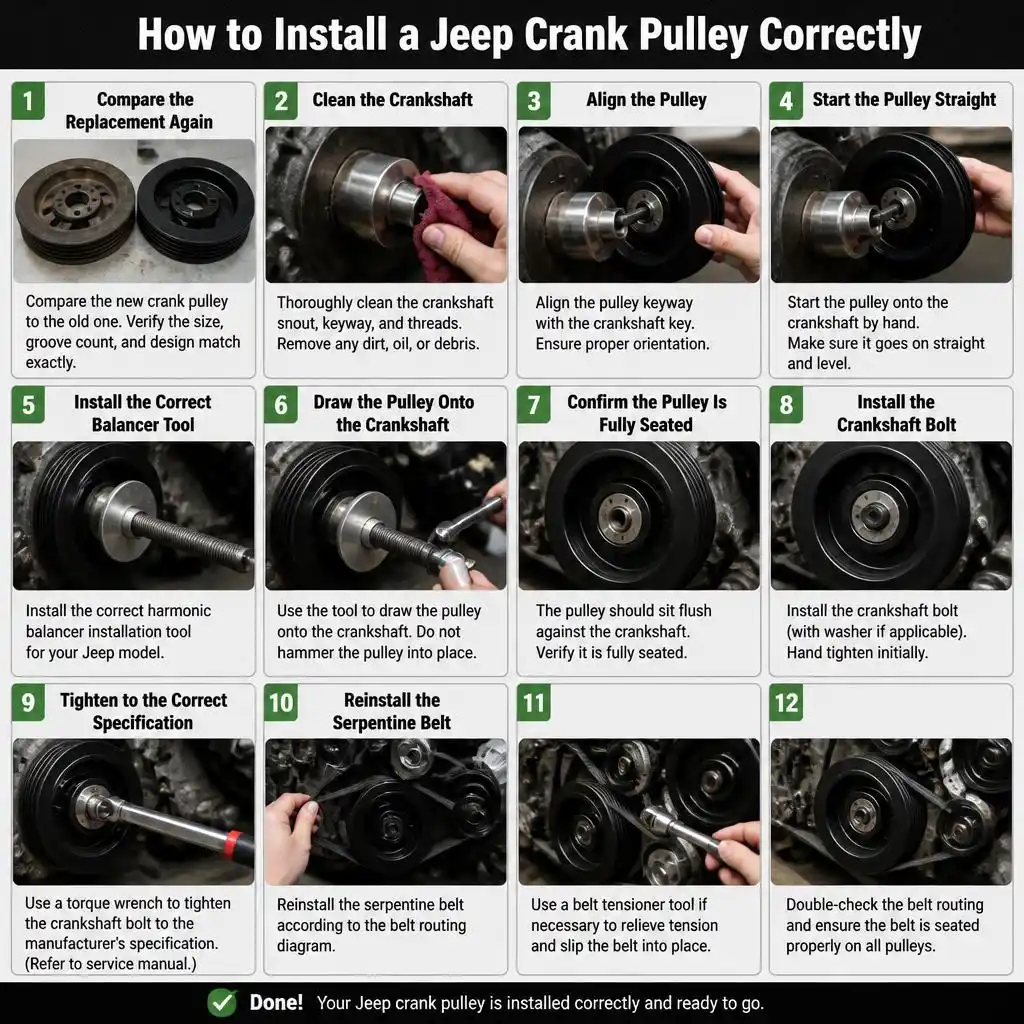
Step 1: Compare the Replacement Again
Before installation, verify the new pulley matches the old one.
It is much easier to correct a wrong part while it is still sitting on the workbench.
Step 2: Clean the Crankshaft
Remove dirt, corrosion, or debris from the crankshaft mating area without damaging the surface.
Clean threads are especially important when using a threaded installation tool.
Step 3: Align the Pulley
Position the pulley according to its indexing or keyway design.
Do not attempt to overcome incorrect alignment with extra force.
If it does not start correctly, remove it and inspect the alignment again.
Step 4: Start the Pulley Straight
The pulley needs to begin square to the crankshaft.
A crooked start can cause binding and damage.
Step 5: Install the Correct Balancer Tool
Thread the correct installer adapter into the crankshaft by hand.
Make sure it has adequate thread engagement before applying installation force.
Then assemble the bearing, nut, spacer, or driver components according to your tool manufacturer’s instructions.
Step 6: Draw the Pulley Onto the Crankshaft
Turn the installer slowly and steadily.
Watch the pulley from more than one angle.
It should move inward evenly.
If resistance suddenly becomes abnormal, stop.
Possible causes include:
- Incorrect alignment
- Wrong tool adapter
- Pulley binding
- Damaged crankshaft surface
- Pulley already reaching its intended position
Step 7: Confirm the Pulley Is Fully Seated
Do not judge installation depth by how difficult the installer becomes to turn.
Compare the new pulley position with:
- Factory service information
- Adjacent accessory pulley alignment
- Known reference points
- Original installation position, if recorded
Step 8: Install the Crankshaft Bolt
Follow the exact fastener procedure specified for your engine.
Some engine fasteners may have special reuse or replacement requirements.
If you cannot confirm whether the bolt is reusable, verify that before completing the repair.
Step 9: Tighten to the Correct Specification
Use the correct torque procedure for your specific Jeep.
This is one area where guessing is unacceptable.
Do not use a torque value from a random Wrangler, Cherokee, Grand Cherokee, Liberty, or HEMI forum post unless it exactly matches your vehicle and is confirmed against reliable service information.
Step 10: Reinstall the Serpentine Belt
Route the belt correctly around every pulley.
Make sure all belt ribs sit completely inside the pulley grooves.
A belt one groove out of position can quickly become damaged.
How Do You Know the Crank Pulley Is Fully Seated?
A properly installed pulley should sit squarely and align correctly with the rest of the belt drive.
Check these points before starting the engine:
- Pulley appears straight on the crankshaft.
- Pulley depth matches the expected position.
- Serpentine belt aligns with neighboring pulleys.
- Belt ribs sit correctly in the grooves.
- No unusual gap is visible.
- Crank bolt has been tightened using the correct procedure.
If you recorded measurements or photographs before removal, compare them now.
Common Jeep Crank Pulley Installation Mistakes
Avoiding these mistakes can save you from doing the entire job twice.
Hammering the Pulley Onto the Crankshaft
A hammer is not a substitute for the correct installer.
Heavy impact can damage the pulley, damper, crankshaft, or related components.
Using the Crank Bolt to Pull the Pulley On Too Early
If the pulley is not far enough onto the crankshaft, there may not be sufficient safe thread engagement for the crank bolt.
A dedicated installation tool is designed to control this process more effectively.
Installing the Pulley Crooked
If the pulley starts at an angle, stop immediately.
Forcing it farther will not straighten a bad start.
Forcing the Wrong Installer Adapter
An adapter should thread in smoothly by hand.
If you need a breaker bar to make the adapter enter the crankshaft, something is wrong.
Guessing the Torque
“Really tight” is not a torque specification.
Use the service procedure for your exact engine.
Ignoring Belt Alignment
Even if the engine starts normally, poor pulley alignment can damage the belt over time.
Inspect the belt while the engine is off and again from a safe distance after startup.
Crank Pulley Won’t Come Off? Try These Checks
A stuck crank pulley is common on older vehicles.
Crankshaft Bolt Won’t Loosen
First confirm:
- Correct socket
- Secure holding method
- Correct service procedure
- Adequate tool strength
If the bolt head begins to round, stop before the problem gets worse.
Pulley Spins While Loosening the Bolt
You probably need a better holding method.
A proper harmonic balancer holding tool can keep the pulley secure while the crank bolt is serviced. OTC’s Chrysler balancer service set includes a dedicated holding tool for this purpose.
Puller Keeps Slipping
Check whether:
- The puller is correct for the pulley.
- The puller is centered.
- All attachment points are engaged equally.
- The forcing screw is aligned with the crankshaft.
Pulley Is Corroded in Place
Do not immediately attack it with a large hammer.
Controlled puller pressure is safer than uncontrolled impact.
If corrosion is severe, clean exposed areas and follow appropriate service practices before increasing force.
New Jeep Crank Pulley Won’t Go On
If the replacement pulley refuses to install, stop and diagnose the cause.
Wrong Replacement Part
Compare the old and new parts again.
Small differences in bore, offset, or hub design matter.
Keyway Is Misaligned
A keyed pulley cannot seat correctly if the key and pulley slot are not aligned.
Wrong Installer Thread
Never force the installer.
Verify adapter diameter and thread pitch.
Pulley Started Crooked
Back it off and restart.
Continuing to tighten the installer can damage both mating surfaces.
Crankshaft Threads Are Damaged
If the installer cannot thread smoothly into the crankshaft, inspect the threads closely.
Correct thread damage before proceeding.
Should You Replace the Front Crankshaft Seal While the Pulley Is Off?
Not automatically.
However, removing the crank pulley may expose the front crankshaft seal, making this a convenient time to inspect it.
Consider addressing the seal if you find:
- Fresh oil around the seal
- Oil tracking behind the pulley
- A known front seal leak
- Physical seal damage
If the seal is dry and healthy, replacing it simply because it is visible may not be necessary.
Follow the service information for your engine before disturbing a good seal.
Should You Reuse the Jeep Crankshaft Pulley Bolt?
There is no safe universal answer for every Jeep engine.
Fastener design and service requirements vary.
Before reusing the old bolt, verify:
- Factory replacement instructions
- Bolt condition
- Thread condition
- Washer condition
- Whether the bolt is specified as single-use
- Correct tightening procedure
If the bolt has damaged threads, a rounded head, corrosion, stretching, or other obvious damage, do not blindly reinstall it.
Mopar parts catalogs also show that crankshaft/damper hardware can be application-specific, which is another reason to confirm the correct part rather than assuming one crank bolt fits every Jeep.
OEM vs Aftermarket Jeep Crank Pulley
Both OEM and quality aftermarket replacements can be options, but fitment matters more than simply choosing the cheapest listing.
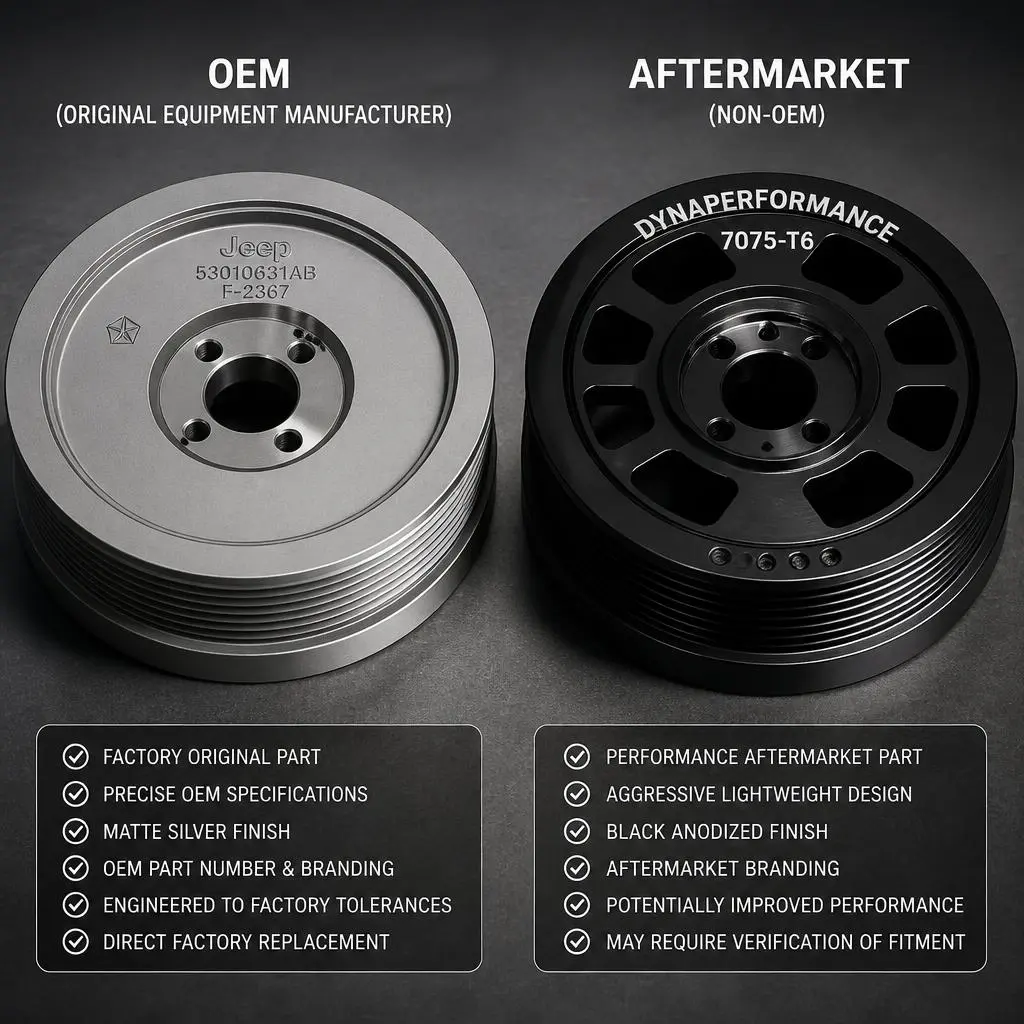
OEM Crankshaft Damper
An OEM Mopar damper is designed around a specified factory application.
Possible benefits include:
- Factory-targeted fitment
- Known OE configuration
- Easier part-number matching
Mopar currently lists crankshaft dampers for specific Jeep/Chrysler/Ram engine applications rather than treating them as one universal part.
Aftermarket Harmonic Balancer
Aftermarket options can be useful when they are made for the correct engine and vehicle.
Before buying, verify:
- Exact vehicle compatibility
- Engine
- Pulley diameter
- Groove configuration
- Hub design
- Warranty
- Manufacturer reputation
Avoid choosing a balancer based only on the lowest price.
How Much Does Jeep Crank Pulley Replacement Cost?
The total cost can vary significantly because there are several parts to the job.
Your DIY total may include:
- Replacement crank pulley or harmonic balancer
- New crankshaft bolt if required
- Puller
- Installer
- Torque wrench
- Serpentine belt if worn
- Front seal if leaking
- Additional tools required for access
Professional repair cost also depends on:
- Jeep model
- Engine
- Labor time
- Local labor rates
- Parts selection
- Additional damage found during inspection
If you already own the basic tools, DIY replacement can be much less expensive. If you need to purchase every specialty tool for a single repair, the savings may be smaller.
How Long Does a Jeep Crank Pulley Replacement Take?
There is no reliable single time for every Jeep.
A straightforward job with good access and the correct tools can be much faster than a repair involving:
- Seized crank bolt
- Rust
- Limited engine-bay clearance
- Damaged threads
- Wrong replacement part
- Missing specialty tools
- Front seal replacement
- Belt-drive repairs
For a first-time DIY mechanic, it is better to plan enough time to work carefully rather than trying to finish within an aggressive deadline.
Can You Replace a Jeep Crank Pulley Without a Special Tool?
Sometimes people find improvised ways to remove or install a pulley.
That does not make those methods a good idea.
For a press-fitted damper, the correct puller and installer provide much better control.
A dedicated puller helps apply removal force in a predictable way, while an installer draws the pulley onto the crankshaft using the proper threaded connection. Tool manufacturers specifically design harmonic balancer tools for these operations.
If your Jeep requires a specialty puller, renting or borrowing the correct tool is usually preferable to damaging the crankshaft while trying to avoid it.
DIY vs Mechanic: Should You Replace It Yourself?
Use your experience level honestly.
| Situation | DIY or Professional? |
|---|---|
| You have correct tools and repair experience | DIY may be reasonable |
| You have verified service information | DIY may be reasonable |
| Crank bolt is badly seized | Professional help may be safer |
| Crankshaft threads are damaged | Professional repair recommended |
| Pulley broke during removal | Professional inspection may be wise |
| You cannot confirm torque procedure | Stop and verify first |
| You are uncomfortable working around engine timing components | Professional service recommended |
There is no prize for finishing a repair without the correct equipment.
Stopping before causing damage is often the least expensive decision.
After Installation: Final Checks
Do not close the hood immediately after tightening the last bolt.
Perform a complete inspection.
Before Starting the Engine
Check:
- Crank bolt completed according to specification
- Serpentine belt routed correctly
- Belt ribs seated correctly
- All removed components reinstalled
- No tools left in the engine bay
- Electrical connections restored
- Battery connected correctly if it was disconnected
First Startup
Start the engine and observe from a safe position.
Look for:
- Pulley wobble
- Belt wandering
- Abnormal vibration
- Squealing
- Knocking
- Fluid leakage
Never reach into the engine bay near a moving belt.
After a Short Drive
Once the engine has cooled again, inspect:
- Belt condition
- Pulley alignment
- Oil leakage
- Unusual sounds
- Loose surrounding components
If something looks wrong, investigate it before continuing normal driving.
Jeep Crank Pulley Troubleshooting Chart
| Problem | Possible Cause | What to Check |
|---|---|---|
| New pulley wobbles | Incorrect seating or damaged part | Pulley alignment and fitment |
| Belt squeals | Misalignment or belt problem | Belt, tensioner and pulley position |
| Belt walks sideways | Pulley not aligned | Pulley depth and accessory alignment |
| Pulley will not install | Wrong part or alignment | Part number, keyway and crank surface |
| Installer will not thread in | Wrong adapter or damaged threads | Thread size and crank threads |
| Pulley will not come off | Incorrect puller or corrosion | Tool setup and attachment |
| Vibration remains | Problem may be elsewhere | Mounts, accessories and engine condition |
| Oil appears behind pulley | Front crank seal may leak | Seal area |
| Crank bolt will not loosen | Holding/tool issue | Service method and holding tool |
| Noise remains after repair | Another belt component may be worn | Idler, tensioner and accessories |
Jeep Crank Pulley Replacement by Popular Engine Type
The general concept is similar across many Jeeps, but the details can change significantly.
Jeep 3.6L Pentastar Crank Pulley Replacement
Before working on a 3.6L Jeep, confirm:
- Correct damper for the exact vehicle
- Correct removal tool
- Correct installer
- Crankshaft bolt procedure
- Required access steps
Mopar currently lists crankshaft damper assemblies specifically associated with 3.6L V6 applications, illustrating why matching the exact engine matters.
Jeep 4.0L Harmonic Balancer Replacement
The Jeep 4.0L is common in older Wrangler and Cherokee platforms, but model year still matters.
Verify the balancer, crankshaft hardware, pulley configuration, and service specification for the exact application rather than assuming every 4.0L uses an identical procedure.
Jeep 4.7L Crank Pulley Replacement
Check engine access, puller requirements, crank bolt specifications, and replacement pulley fitment before beginning.
Do not purchase a tool solely because another Jeep owner used it on a different engine.
Jeep 5.7L HEMI Harmonic Balancer Replacement
Some professional installer kits include long adapters specifically intended for deep balancer applications, including certain HEMI-related configurations.
That makes installer reach an important factor to verify before the old pulley is removed.
Frequently Asked Questions About Jeep Crank Pulley Installation
Is a crank pulley the same as a harmonic balancer?
On many Jeep applications, the accessory-drive pulley and vibration-damping assembly are combined or discussed as the same component. You may also see the terms crankshaft damper or vibration damper. Always verify the specific component used on your engine.
Do I need a special tool to remove a Jeep crank pulley?
Many press-fitted crank pulleys or harmonic balancers require a dedicated puller. The correct tool depends on the pulley and engine design.
What tool installs a Jeep harmonic balancer?
A harmonic balancer installer is generally used to draw a press-fitted balancer onto the crankshaft in a controlled manner. The installer must have the correct threaded adapter and sufficient reach for your engine.
Can I hammer a harmonic balancer onto the crankshaft?
Hammering a press-fit harmonic balancer is not a recommended substitute for the correct installation tool. Impact can damage the pulley, crankshaft, damping material, or related components.
Can I use the crankshaft bolt to pull the pulley on?
Do not assume this is safe. If the pulley has not moved far enough onto the crankshaft, the bolt may have inadequate thread engagement. Follow the engine-specific service procedure and use a proper installer when required.
Why won’t my Jeep crank pulley come off?
Common reasons include an incorrect puller, a poorly centered puller, corrosion, insufficient tool clearance, or a crank bolt that has not been completely removed.
Why won’t the new harmonic balancer go on?
Check for incorrect fitment, misaligned keyway or indexing, a dirty crankshaft surface, damaged threads, a crooked starting position, or the wrong installer adapter.
How tight should a Jeep crank pulley bolt be?
There is no single torque specification for every Jeep. Use the factory specification for your exact year, model, engine, and crankshaft fastener.
Can a bad crank pulley damage the serpentine belt?
A pulley that is damaged, misaligned, or wobbling can contribute to abnormal belt tracking or wear. However, belt problems can also come from tensioners, idlers, accessories, or incorrect belt installation.
Why is my new crank pulley wobbling?
Stop and inspect the installation. Possible causes include incorrect seating, wrong fitment, damaged components, debris between mating surfaces, or another rotating component creating the appearance of wobble.
Should I replace the serpentine belt at the same time?
Not automatically, but pulley replacement is a good opportunity to inspect the belt. Replace it if it is cracked, frayed, contaminated, badly glazed, or otherwise worn.
Should I replace the front crank seal while the pulley is removed?
Only when inspection or service history gives you a reason. If the seal is leaking, pulley removal may create convenient access. If it is dry and healthy, unnecessary replacement may add work without solving a problem.
Can I drive with a wobbling crank pulley?
A visibly abnormal crank pulley should be inspected promptly. Continuing to drive can risk belt problems or further damage depending on the cause and severity.
Final Thoughts
A successful Jeep crank pulley installation depends less on brute force and more on preparation.
Start by confirming the exact Jeep year, model, and engine. Match the replacement harmonic balancer or crank pulley carefully. Then make sure your puller and installer actually fit that application before removing the original part.
During installation, keep the pulley straight, protect the crankshaft threads, confirm the pulley is fully seated, route the serpentine belt correctly, and use the factory tightening procedure for the crankshaft bolt.
The biggest mistakes happen when a pulley is forced into place, the wrong installer is used, or a torque specification is copied from a different engine.
Whether you are working through a Jeep Innovators crank pulley install, replacing a worn harmonic balancer, or simply trying to stop a wobbling serpentine belt, the same principle applies: use the correct tool for the exact Jeep in front of you.
A little extra time spent checking fitment and service information before the repair can save hours of trouble after it.